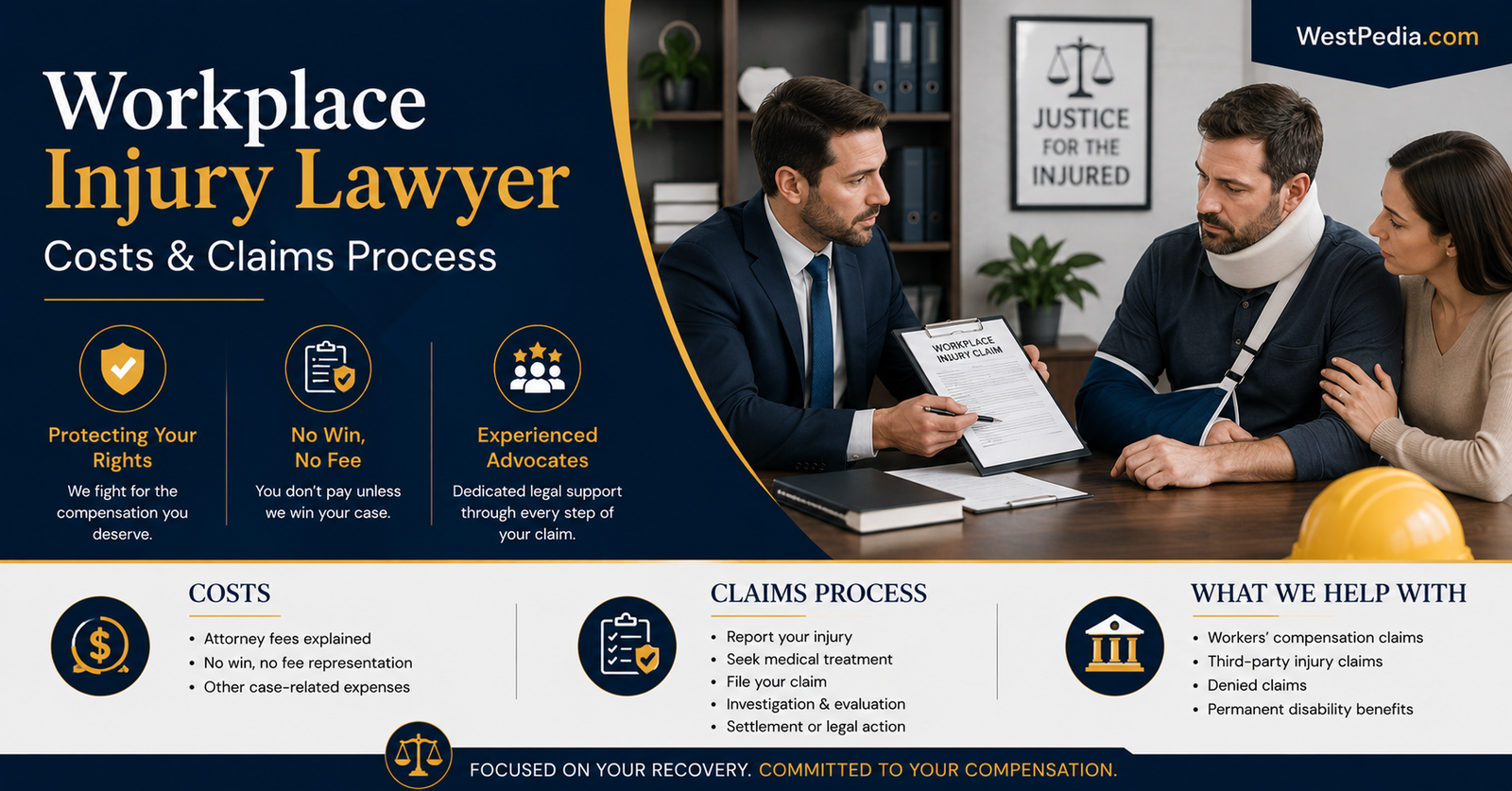
A workplace injury lawyer helps employees understand their legal options after a work-related injury or occupational illness. Depending on the circumstances, an attorney may assist with workers’ compensation claims, third-party injury claims, appeals, settlement negotiations, and court proceedings while protecting the employee’s legal rights.
Workplace Injury Lawyer: Costs, Claims Process & Hiring Guide
A workplace injury can affect your health, income, career, and financial stability. Whether you were injured in a construction accident, warehouse incident, office accident, manufacturing facility, transportation job, or another work environment, understanding your legal rights is an important first step.
Many people search for a workplace injury lawyer because they want answers to practical questions such as whether they qualify for workers’ compensation, whether another party may be legally responsible, how much hiring an attorney costs, and what the claims process looks like.
This guide explains what workplace injury lawyers do, the types of cases they handle, attorney fee structures, eligibility requirements, evidence commonly used in claims, and the initial stages of the legal process.
What Is a Workplace Injury Lawyer?
A workplace injury lawyer represents employees who suffer injuries or occupational illnesses arising out of their employment. Depending on the facts of the case, the attorney may assist with workers’ compensation benefits, third-party personal injury claims, settlement negotiations, appeals, or litigation.
Workplace injury lawyers also help clients understand applicable deadlines, prepare legal documents, communicate with insurers, and gather evidence supporting their claims.
When Should You Hire a Workplace Injury Lawyer?
While some workplace injury claims are resolved without significant legal disputes, professional legal guidance may be helpful when benefits are denied, liability is disputed, or the injury is serious.
- Your workers’ compensation claim has been denied.
- Your employer disputes that the injury happened at work.
- You suffered a permanent or catastrophic injury.
- A third party may have contributed to the accident.
- You cannot return to your previous job.
- Your medical treatment has been limited or denied.
- You are offered a settlement and want legal advice before accepting.
- You believe retaliation occurred after reporting a workplace injury.
Common Workplace Injuries
| Injury Type | Examples |
|---|---|
| Slip and Fall Injuries | Wet floors, uneven surfaces, falling objects |
| Back and Neck Injuries | Heavy lifting, repetitive strain, falls |
| Head and Brain Injuries | Falling equipment, vehicle accidents, impact injuries |
| Broken Bones | Falls, machinery accidents, construction incidents |
| Burn Injuries | Electrical accidents, chemical exposure, fires |
| Repetitive Stress Injuries | Carpal tunnel syndrome and repetitive motion disorders |
| Occupational Illnesses | Chemical exposure, respiratory diseases, hearing loss |
| Amputations | Industrial machinery and manufacturing accidents |
Industries Where Workplace Injuries Commonly Occur
- Construction
- Manufacturing
- Warehousing and logistics
- Healthcare
- Transportation
- Agriculture
- Retail
- Hospitality
- Oil and gas
- Public safety occupations
Types of Workplace Injury Cases
| Case Type | Description |
|---|---|
| Workers’ Compensation Claims | Benefits for eligible work-related injuries or illnesses |
| Construction Site Accidents | Falls, equipment failures, and unsafe work conditions |
| Industrial Accidents | Factory and manufacturing injuries |
| Third-Party Injury Claims | Claims against parties other than the employer when permitted by law |
| Occupational Disease Claims | Illnesses resulting from workplace exposure |
| Wrongful Death Claims | Fatal workplace accidents under applicable laws |
What Does a Workplace Injury Lawyer Do?
- Evaluate the circumstances of the workplace injury.
- Explain available legal options.
- Review workers’ compensation eligibility.
- Gather medical records and accident reports.
- Interview witnesses.
- Communicate with insurance companies.
- Calculate potential damages where applicable.
- Negotiate settlements.
- Represent clients during hearings and litigation.
- Handle appeals when claims are denied.
Who May Be Eligible to File a Workplace Injury Claim?
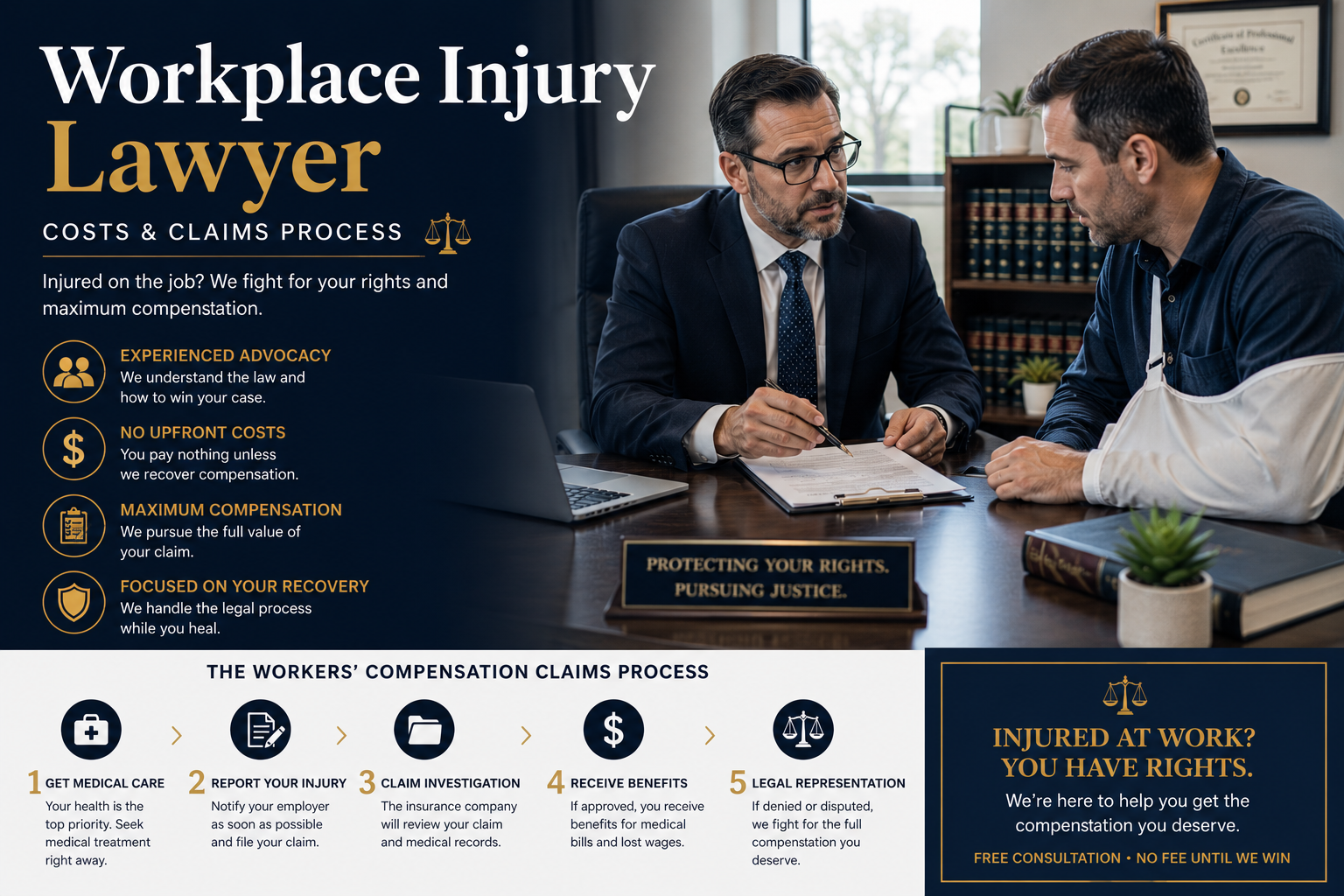
Eligibility depends on employment status, the circumstances of the injury, and the laws governing workers’ compensation and personal injury claims in the applicable jurisdiction.
| Requirement | Description |
|---|---|
| Employment Relationship | The injured individual generally must qualify under applicable employment laws. |
| Work-Related Injury | The injury generally must arise out of or occur during employment. |
| Timely Reporting | Many jurisdictions require prompt reporting of workplace injuries. |
| Medical Documentation | Medical evidence typically supports the claim. |
Evidence Commonly Used in Workplace Injury Claims
- Incident reports.
- Medical records.
- Photographs of the accident scene.
- Witness statements.
- Safety inspection reports.
- Employment records.
- Training records.
- Maintenance logs.
- Surveillance footage when available.
- Expert opinions.
How Much Does a Workplace Injury Lawyer Cost?
Attorney fee arrangements vary depending on the type of claim, applicable laws, and the services provided. Many personal injury matters are handled through contingency fee agreements, while other workplace-related legal services may use different billing structures.
| Fee Structure | Description |
|---|---|
| Contingency Fee | Common in many eligible personal injury matters, where fees are generally tied to any recovery. |
| Hourly Billing | May be used for certain legal services or consultations. |
| Flat Fee | Sometimes available for limited legal services. |
| Case Expenses | Costs such as medical records, filing fees, and expert witnesses may be addressed separately in the fee agreement. |
Before hiring an attorney, review the written fee agreement carefully and ask questions about litigation expenses, billing practices, and how costs are handled if the claim is unsuccessful.
Workers’ Compensation vs. Personal Injury Lawsuit
| Workers’ Compensation | Personal Injury Claim |
|---|---|
| Often provides statutory benefits for eligible workplace injuries. | May be available when a legally responsible third party contributed to the injury. |
| Usually does not require proving employer negligence. | Generally requires establishing legal liability. |
| Benefits vary according to applicable law. | Available damages depend on the facts and governing law. |
| Procedures are governed by workers’ compensation laws. | Follows civil litigation procedures. |
Workplace Injury Claim Process
Step 1: Report the Injury
Notify your employer as soon as reasonably possible after the workplace injury. Many jurisdictions require employees to report work-related injuries within specific timeframes.
Step 2: Seek Medical Treatment
Prompt medical evaluation helps protect your health while also creating documentation regarding the nature and extent of the injury.
Step 3: Gather Evidence
Collect accident reports, photographs, witness information, medical records, and any documentation relating to the incident.
Step 4: Consult a Workplace Injury Lawyer
An attorney can evaluate your circumstances, explain available legal options, identify applicable deadlines, and determine whether additional claims beyond workers’ compensation may be available.
Step 5: File the Appropriate Claim
Depending on the circumstances, this may involve filing a workers’ compensation claim, pursuing an appeal, or initiating a third-party personal injury claim where permitted by law.
Step 6: Claim Investigation
After a claim is filed, the employer, insurance carrier, or other involved parties typically investigate the circumstances of the workplace injury. Your attorney may continue gathering evidence, consulting experts when appropriate, and responding to requests for additional information.
The investigation may include:
- Reviewing accident reports.
- Obtaining complete medical records.
- Interviewing witnesses.
- Inspecting the accident location.
- Reviewing workplace safety policies.
- Analyzing surveillance footage, if available.
- Consulting medical or occupational experts.
Step 7: Employer and Insurance Company Review
The employer’s insurance company may review the claim to determine eligibility for benefits, evaluate medical evidence, and assess the circumstances surrounding the injury.
Depending on the case, the insurer may:
- Approve the claim.
- Request additional documentation.
- Schedule an independent medical examination where permitted.
- Dispute part or all of the claim.
- Offer a settlement.
Step 8: Settlement Negotiations
Many workplace injury claims are resolved through negotiated settlements. During negotiations, the attorney evaluates proposed settlement terms, explains their legal effect, and works to protect the client’s interests.
Before accepting any settlement, injured workers should understand how it may affect future medical benefits, wage replacement, and other legal rights.
Step 9: Administrative Hearing or Trial
If a dispute cannot be resolved through negotiation, the matter may proceed to an administrative hearing, workers’ compensation appeal, or civil court, depending on the nature of the claim and applicable law.
During the hearing or trial, both parties present evidence, question witnesses, and make legal arguments before the decision-maker.
Settlement vs. Trial
| Settlement | Trial or Hearing |
|---|---|
| May resolve the claim sooner. | Often requires more time. |
| Provides greater certainty regarding the outcome. | The final decision is made by a judge, administrative body, or jury. |
| Usually avoids lengthy litigation. | May involve additional legal procedures. |
| Both parties voluntarily agree. | A decision is imposed if no agreement is reached. |
Compensation That May Be Available
The benefits or damages available depend on the type of claim, applicable law, and the facts of the case.
| Potential Recovery | Description |
|---|---|
| Medical Expenses | Eligible medical treatment related to the workplace injury. |
| Lost Wages | Compensation for time away from work where permitted. |
| Temporary Disability Benefits | Benefits available during recovery under applicable law. |
| Permanent Disability Benefits | Benefits that may apply when permanent impairment exists. |
| Vocational Rehabilitation | Training or assistance returning to suitable employment where available. |
| Third-Party Personal Injury Damages | Additional damages may be available in eligible third-party claims. |
The specific compensation available varies significantly depending on the jurisdiction, the nature of the injury, and whether the claim involves workers’ compensation or civil litigation.
Factors That May Affect Compensation
| Factor | Potential Impact |
|---|---|
| Severity of the Injury | More serious injuries may involve greater medical treatment and disability. |
| Medical Documentation | Complete records help support the claim. |
| Lost Income | Employment history may affect wage-related benefits. |
| Permanent Impairment | May influence long-term benefits where applicable. |
| Available Evidence | Photographs, witnesses, and reports may strengthen the claim. |
| Applicable State Law | Benefit rules and legal procedures vary by jurisdiction. |
Third-Party Workplace Injury Claims
Although workers’ compensation often provides benefits regardless of fault, there are situations where another person or company—not the employer—may have contributed to the accident.
Examples include:
- Defective machinery or equipment.
- Negligent subcontractors.
- Motor vehicle accidents involving another driver.
- Unsafe property owned by another business.
- Faulty safety equipment.
- Manufacturing defects.
Whether a third-party claim is available depends on the facts of the case and the laws of the applicable jurisdiction.
Statute of Limitations
Workplace injury claims and workers’ compensation claims are subject to legal deadlines. These deadlines differ depending on the jurisdiction and the type of claim involved.
Missing an applicable filing deadline may affect your ability to recover benefits or pursue legal action. Consulting an attorney promptly may help ensure compliance with reporting and filing requirements.
How to Choose the Right Workplace Injury Lawyer
- Look for experience handling workplace injury and workers’ compensation cases.
- Ask whether the attorney has handled cases involving injuries similar to yours.
- Understand the attorney’s fee structure before signing an agreement.
- Discuss communication expectations and case updates.
- Ask who will personally manage your case.
- Review professional qualifications and client feedback.
- Determine whether the attorney has experience with hearings, appeals, and litigation.
Questions to Ask Before Hiring a Lawyer
- How much of your practice focuses on workplace injury law?
- Have you handled cases similar to mine?
- How are attorney fees calculated?
- Will my claim involve workers’ compensation, a third-party lawsuit, or both?
- What documents should I gather?
- How will you communicate updates about my case?
- Who will be my primary contact?
- What legal deadlines apply to my claim?
- Will expert witnesses likely be needed?
- What happens if my claim is denied?
Benefits of Hiring a Workplace Injury Lawyer
- Professional evaluation of available legal options.
- Assistance gathering medical records and evidence.
- Guidance regarding workers’ compensation procedures.
- Representation during settlement negotiations and hearings.
- Help responding to claim denials or appeals.
- Knowledge of filing deadlines and legal requirements.
- Protection of your legal rights throughout the process.
Risks and Considerations
- Some claims involve lengthy investigations.
- Benefits and legal rights vary by jurisdiction.
- Settlement negotiations may not always succeed.
- Medical evidence often plays a significant role in claim outcomes.
- No attorney can ethically guarantee approval of a claim or a specific recovery.
Important Legal Considerations
Workers’ compensation laws, workplace safety regulations, filing deadlines, and available legal remedies vary significantly among jurisdictions.
Promptly reporting an injury, obtaining medical treatment, preserving evidence, and consulting a qualified attorney may help you better understand your legal options.
Every workplace injury case is unique, and past results do not guarantee future outcomes.
Educational Disclaimer
This information is for educational purposes only and should not be considered legal advice. Laws and legal procedures may vary by jurisdiction.
Frequently Asked Questions
What does a workplace injury lawyer do?
A workplace injury lawyer assists injured employees with workers’ compensation claims, third-party injury claims, appeals, settlement negotiations, and legal representation when disputes arise.
Do I need a lawyer for a workplace injury?
Some claims are resolved without legal representation, but consulting an attorney may be helpful if your claim is denied, liability is disputed, or your injury is serious.
How much does a workplace injury lawyer cost?
Fee arrangements vary. Many personal injury matters are handled through contingency fee agreements, while other services may use different billing methods.
Can I sue my employer after a workplace injury?
Whether you may bring a lawsuit depends on the applicable laws and the circumstances of your case. In some situations, workers’ compensation is the exclusive remedy, while separate third-party claims may also be available.
What if my workers’ compensation claim is denied?
Depending on the jurisdiction, you may have the right to appeal or seek additional review. An attorney can explain the available procedures.
What evidence is important in a workplace injury claim?
Medical records, accident reports, witness statements, photographs, employment records, and safety documentation are commonly used.
How long do workplace injury claims take?
The timeline depends on the complexity of the claim, medical treatment, insurance review, and whether disputes require hearings or litigation.
Can I receive compensation if another company caused my injury?
In some cases, a third-party claim may be available if someone other than your employer was legally responsible for the accident.
Can a workplace injury lawyer guarantee compensation?
No. Attorneys cannot ethically guarantee claim approval, settlement amounts, or court outcomes.
How do I choose the right workplace injury lawyer?
Consider experience, communication, fee arrangements, professional qualifications, and familiarity with workplace injury and workers’ compensation cases.
Related Topics
- Construction Accident Lawyer: Legal Rights After a Job Site Injury
- Construction Accident Claim Lawyer: Benefits, Claims and Appeals Guide
- Construction Site Injury Lawyer: Costs, Process and Hiring Guide
- Personal Injury Lawyer: Understanding Injury Claims and Compensation
- Wrongful Death Lawyer: Legal Guide for Fatal Workplace Accidents