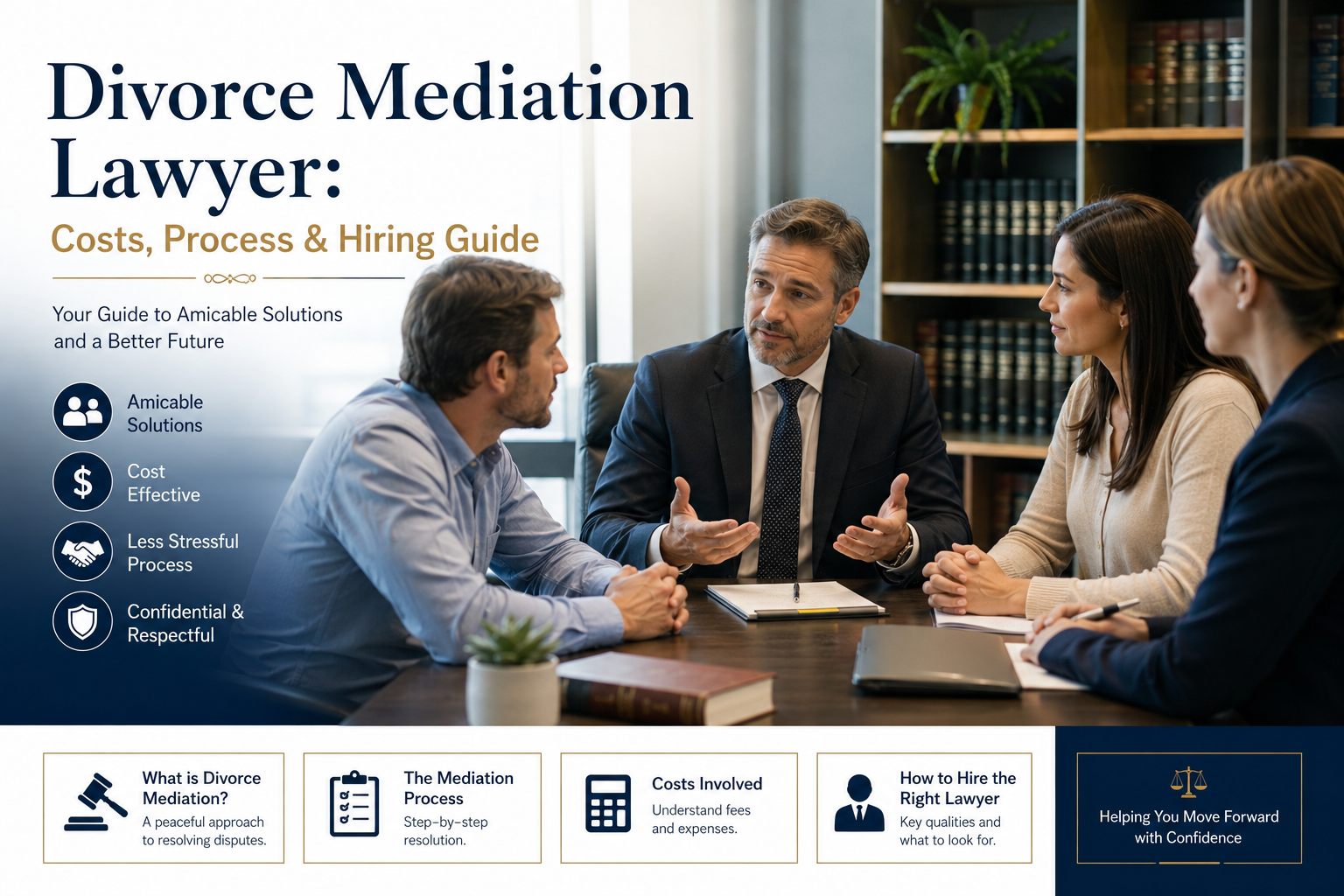
A divorce mediation lawyer helps spouses negotiate agreements regarding child custody, property division, support, and other divorce issues outside traditional courtroom litigation. Mediation often reduces legal costs, encourages cooperation, and may allow couples to resolve disputes more efficiently than contested divorce proceedings.
Divorce Mediation Lawyer: Costs, Process & Hiring Guide
Many couples seeking divorce want to avoid prolonged court battles, reduce legal expenses, and maintain greater control over important family decisions. Divorce mediation offers an alternative dispute resolution process that allows spouses to negotiate and resolve divorce-related issues outside of traditional litigation.
People searching for a divorce mediation lawyer are often interested in understanding how mediation works, whether it is appropriate for their situation, how much it costs, and what legal protections are available throughout the process.
This guide explains what a divorce mediation lawyer does, mediation procedures, attorney fees, common requirements, and factors to consider before choosing mediation.
What Is a Divorce Mediation Lawyer?
A divorce mediation lawyer is a family law attorney who assists spouses during the mediation process. Depending on the circumstances, the attorney may serve as a neutral mediator or independently advise one spouse regarding proposed settlement terms.
Mediation focuses on helping spouses negotiate mutually acceptable agreements involving family, financial, and parenting issues without requiring a judge to decide every disputed matter.
What Is Divorce Mediation?
Divorce mediation is a structured negotiation process in which spouses work with a neutral mediator to discuss and resolve issues related to their divorce.
Unlike traditional litigation, mediation emphasizes communication, cooperation, and voluntary agreement rather than courtroom advocacy.

Issues Commonly Addressed During Mediation
- Child custody and parenting schedules.
- Child support arrangements.
- Spousal support or alimony.
- Division of marital property.
- Allocation of debts and liabilities.
- Retirement and investment accounts.
- Business ownership interests.
- Future communication and co-parenting arrangements.
When Should You Consider Divorce Mediation?
Mediation may be appropriate when both spouses are willing to communicate and participate in good-faith negotiations.
- Both spouses wish to avoid extensive litigation.
- There is a desire to reduce legal costs.
- Parents want to preserve a cooperative co-parenting relationship.
- Spouses are generally willing to exchange financial information.
- Both parties prefer privacy rather than public court proceedings.
- There is a willingness to compromise.
Mediation may not be appropriate in every case, particularly where significant safety concerns, domestic violence allegations, or severe power imbalances exist.
How Does Divorce Mediation Differ From Litigation?
| Factor | Divorce Mediation | Traditional Litigation |
|---|---|---|
| Decision-Making | Spouses negotiate agreements | Judge decides disputed issues |
| Privacy | Generally more private | Court records may be public |
| Cost | Often lower in many cases | May involve higher litigation expenses |
| Timeline | May resolve disputes more efficiently | Court schedules may extend timelines |
| Communication | Encourages collaboration | Often adversarial |
What Does a Divorce Mediation Lawyer Do?
- Explain family law principles and procedures.
- Facilitate settlement discussions.
- Help identify disputed issues.
- Review financial disclosures.
- Assist in negotiating parenting arrangements.
- Draft or review settlement agreements.
- Advise clients regarding legal rights.
- Prepare final divorce documentation.
- Represent clients if mediation is unsuccessful.
Documents Commonly Needed for Divorce Mediation
- Marriage certificate.
- Tax returns.
- Bank account statements.
- Pay stubs and employment records.
- Mortgage and property documents.
- Retirement account statements.
- Credit card and loan information.
- Insurance policies.
- Business financial records.
- Children’s educational and medical information.
How Much Does a Divorce Mediation Lawyer Cost?
Costs vary depending on case complexity, geographic location, and whether attorneys represent one or both spouses during mediation.
| Fee Structure | Description |
|---|---|
| Hourly Billing | Mediators and attorneys often charge hourly rates |
| Flat Fee | Some mediators offer fixed-fee packages |
| Retainer Fee | Advance deposits may be required |
| Document Preparation Fees | Additional costs for preparing legal filings |
Before beginning mediation, spouses should understand all anticipated fees and obtain written fee agreements whenever possible.
Divorce Mediation Process
Step 1: Initial Consultation
The mediator or attorney evaluates whether mediation is appropriate for the couple’s circumstances.
Step 2: Information Gathering
Both spouses collect financial records, property information, and documents relevant to the divorce.
Step 3: Identification of Issues
The parties identify issues requiring resolution, such as custody, support, and property division.
Step 4: Mediation Sessions
The mediator facilitates discussions designed to help spouses negotiate acceptable solutions.
Step 5: Negotiation and Compromise
Spouses discuss proposals, exchange information, and work toward settlement terms.
Step 6: Drafting Settlement Agreements
Once agreements are reached, legal documents are prepared reflecting negotiated terms.
Step 7: Independent Legal Review
Many spouses choose to have independent attorneys review proposed agreements before signing.
Step 8: Court Approval
The final agreement is submitted to the court as part of the divorce proceedings.
Benefits of Divorce Mediation
- Often reduces conflict between spouses.
- May lower legal expenses in many cases.
- Provides greater control over outcomes.
- Encourages cooperative co-parenting relationships.
- Offers a more private dispute resolution process.
- May resolve disputes more efficiently than litigation.
Potential Drawbacks of Divorce Mediation
- Mediation requires cooperation from both spouses.
- Not all disputes can be resolved through negotiation.
- Significant power imbalances may affect discussions.
- Additional litigation may be necessary if mediation fails.
- Complex financial matters may require outside experts.
Child Custody and Parenting Plans in Mediation
Parents frequently use mediation to develop customized parenting plans that address:
- Residential schedules.
- Holiday and vacation arrangements.
- Decision-making authority.
- Communication methods.
- Education and healthcare decisions.
- Transportation responsibilities.
Courts generally review parenting agreements to ensure they serve the child’s best interests.
Property Division During Mediation
Property division negotiations often address:
- Family homes.
- Bank accounts.
- Retirement assets.
- Investment accounts.
- Vehicles.
- Business interests.
- Marital debts.
Property division laws vary significantly by jurisdiction.
When Mediation May Not Be Appropriate
| Situation | Consideration |
|---|---|
| Domestic Violence Allegations | Safety concerns may require alternative procedures |
| Hidden Assets | Formal discovery procedures may be necessary |
| Severe Communication Problems | Constructive negotiations may be difficult |
| Substance Abuse Concerns | Additional safeguards may be needed |
| Unwillingness to Compromise | Mediation may be unsuccessful |
How to Choose the Right Divorce Mediation Lawyer
- Look for substantial family law experience.
- Ask about mediation training and certifications.
- Discuss communication practices and availability.
- Understand fee arrangements before beginning.
- Ask how the attorney handles unresolved disputes.
- Determine whether the lawyer acts as a neutral mediator or advocate.
Questions to Ask During a Consultation
- How many divorce mediations have you handled?
- Are you a neutral mediator or individual legal counsel?
- What fee structure do you use?
- How many mediation sessions are typically required?
- What documents should we gather?
- What happens if mediation fails?
- Can each spouse have independent legal counsel?
Important Legal Considerations
Divorce procedures, mediation rules, custody standards, and property division laws vary significantly by jurisdiction.
Consulting an experienced family law attorney may help individuals understand their legal rights and evaluate whether mediation is appropriate for their circumstances.
No attorney or mediator can ethically guarantee specific settlement terms, custody arrangements, or legal outcomes.
Educational Disclaimer
This information is for educational purposes only and should not be considered legal advice. Laws and legal procedures may vary by jurisdiction.
Frequently Asked Questions
What does a divorce mediation lawyer do?
A divorce mediation lawyer helps spouses negotiate agreements regarding custody, support, and property division outside traditional courtroom litigation.
Is divorce mediation less expensive than litigation?
In many cases, mediation may reduce overall legal costs, although expenses vary depending on the complexity of the case.
Do both spouses need separate attorneys during mediation?
Some spouses retain independent attorneys to review agreements, while others rely primarily on the mediator. Practices vary.
Can mediation resolve child custody disputes?
Yes. Mediation is commonly used to develop parenting plans and custody arrangements.
What happens if mediation fails?
If mediation is unsuccessful, spouses may pursue additional negotiations, arbitration, or traditional litigation.
Is mediation legally binding?
Signed settlement agreements may become legally binding once approved by the court, depending on local laws.
How long does divorce mediation take?
Timelines vary depending on the complexity of issues and the willingness of both spouses to negotiate.
Can a mediator provide legal advice to both spouses?
Neutral mediators generally do not provide individualized legal advice to both parties simultaneously.
Can mediation work in high-conflict divorces?
Some high-conflict cases may benefit from mediation, although suitability depends on the specific circumstances.
How do I choose a divorce mediation lawyer?
Consider family law experience, mediation training, communication style, and fee structure.
Related Topics
- Best Divorce Lawyer: Costs, Process and Hiring Guide
- Child Custody Lawyer: Parenting Rights and Legal Process
- Family Law Attorney: Services, Costs and Legal Guidance
- Family Immigration Lawyer
- Best Family Law Attorney