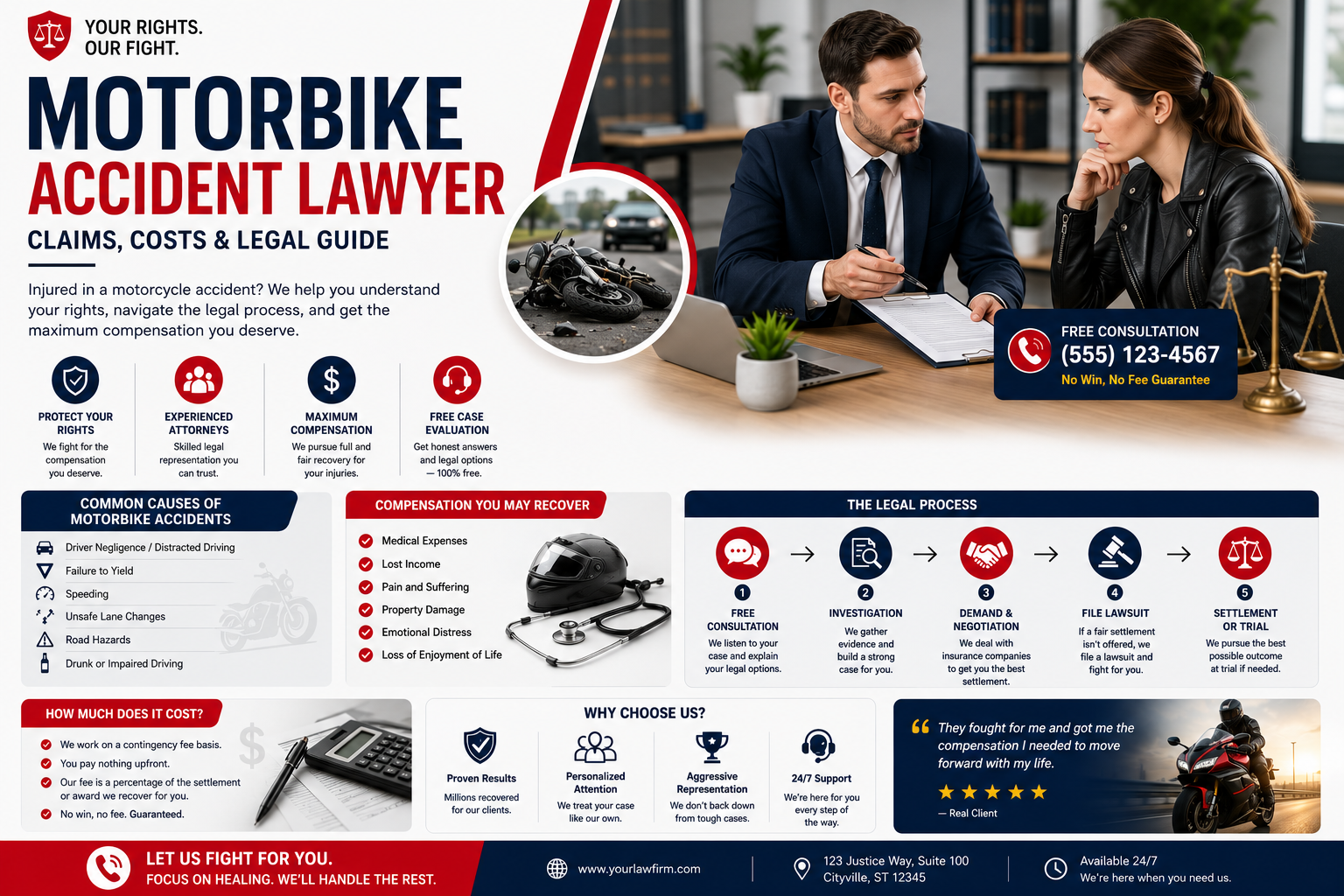
Motorbike accidents can result in serious injuries, expensive medical treatment, lost income, and long-term physical challenges. Unlike passenger vehicles, motorcycles provide less protection during crashes, which often increases the risk of severe injuries for riders. A motorbike accident lawyer helps injured riders understand their legal rights and pursue compensation when another person’s negligence, carelessness, or wrongful actions caused the accident.
These legal professionals handle issues such as insurance claims, accident investigations, evidence collection, liability disputes, settlement negotiations, and court representation when necessary.
Understanding how motorbike accident claims work, when to hire a lawyer, what compensation may be available, and how the legal process operates can help injured riders make informed decisions after a crash.
What Is a Motorbike Accident Lawyer?
A motorbike accident lawyer is a legal professional who represents motorcycle riders injured in accidents caused by another party’s negligence or unlawful conduct.
These attorneys focus on personal injury law and help clients seek compensation for losses related to motorcycle accidents, including medical expenses, lost wages, property damage, rehabilitation costs, and the physical and emotional impact of injuries.
The role of a motorbike accident lawyer is to evaluate the accident circumstances, determine potential liability, protect the injured rider’s legal interests, and guide them through insurance and legal procedures.
Legal Definition of a Motorbike Accident Claim
A motorbike accident claim is a legal request for compensation made by an injured rider against a person, business, insurance company, or other responsible party.
Most motorcycle accident claims are based on negligence. To establish negligence, an injured rider generally needs to show:
- The other party had a duty to act safely.
- The party failed to meet that responsibility.
- The failure caused the motorcycle accident.
- The accident resulted in injuries or financial losses.
The specific requirements depend on the laws of the jurisdiction where the accident occurred.
Why Motorcycle Accident Cases Are Different
Motorcycle accident cases often involve unique legal and factual challenges compared with ordinary vehicle accidents.
Because motorcycles offer limited physical protection, riders frequently experience more serious injuries even when the accident appears minor. Insurance companies may also investigate motorcycle claims carefully because they often involve questions about rider behavior, visibility, road conditions, and fault.
Common challenges in motorbike accident claims include:
- Serious or permanent injuries
- Disputes about who caused the accident
- Bias against motorcycle riders
- Insurance companies minimizing injury claims
- Difficulty proving negligence
- Complex accident reconstruction issues
An experienced motorbike accident lawyer understands these challenges and helps present evidence supporting the rider’s claim.
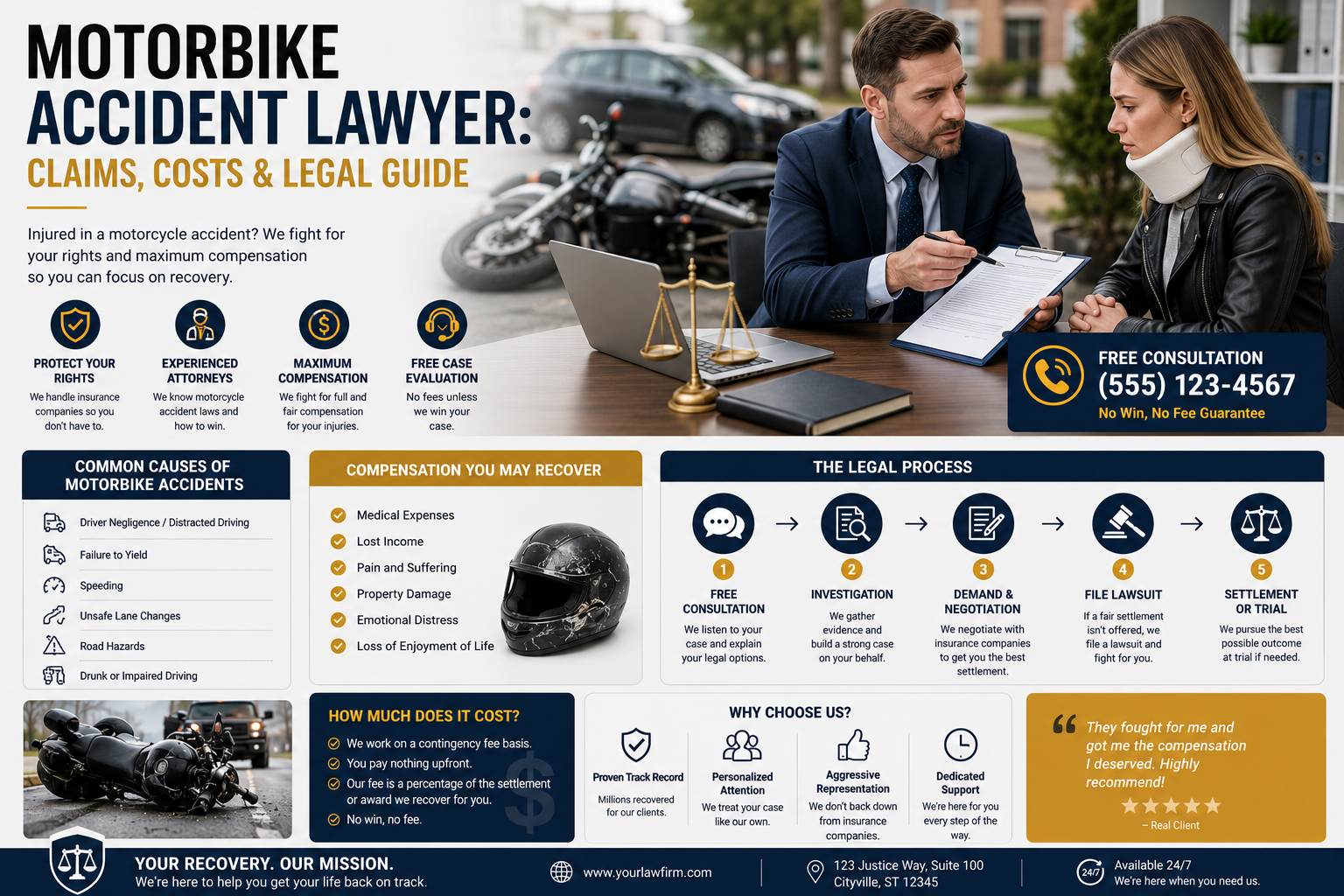
Common Causes of Motorbike Accidents
Motorcycle accidents can happen for many reasons. In many cases, another driver’s negligence contributes to the crash.
1. Distracted Driving
Drivers who use mobile phones, adjust controls, or fail to observe traffic conditions may fail to notice motorcycles nearby.
2. Failure to Yield
Many motorcycle crashes occur when other drivers fail to recognize a motorcycle’s right of way at intersections or during lane changes.
3. Speeding or Reckless Driving
Excessive speed and aggressive driving can reduce reaction time and increase accident severity.
4. Driving Under the Influence
Alcohol or drug impairment can significantly affect judgment, reaction ability, and vehicle control.
5. Unsafe Road Conditions
Potholes, poor road maintenance, debris, and inadequate signage may contribute to motorcycle accidents.
6. Vehicle Defects
Mechanical failures or defective motorcycle parts may create additional legal issues involving manufacturers or other responsible parties.
| Accident Cause | Possible Responsible Party | Common Evidence |
|---|---|---|
| Driver Negligence | Other Motor Vehicle Driver | Police reports, witness statements, video footage |
| Unsafe Road Conditions | Government Entity or Property Owner | Road photographs, maintenance records |
| Vehicle Defect | Manufacturer or Seller | Product records, expert analysis |
| Commercial Vehicle Accident | Company or Driver | Driver records, company documents |
Types of Motorbike Accident Injury Claims
Motorbike accident lawyers handle various types of claims depending on how the accident occurred and who may be legally responsible.
Motor Vehicle Collision Claims
These claims involve accidents between motorcycles and cars, trucks, or other vehicles. Liability may depend on traffic laws, driver actions, and available evidence.
Hit and Run Motorcycle Accidents
When a driver leaves the accident scene, identifying the responsible party can become more challenging. Available insurance coverage and investigation efforts may become important factors.
Motorcycle Product Liability Claims
If a defective motorcycle part contributed to an accident, the manufacturer, distributor, or another party may potentially be involved.
Fatal Motorcycle Accident Claims
When a motorcycle accident results in death, family members may have legal options depending on applicable wrongful death laws.
Commercial Vehicle Motorcycle Accidents
Accidents involving trucks, delivery vehicles, or company vehicles may involve additional liability issues because employers and businesses may share responsibility in certain situations.
Who May Need a Motorbike Accident Lawyer?
Not every motorcycle accident requires legal representation. However, consulting a motorbike accident lawyer may be beneficial when injuries are serious, responsibility is disputed, or insurance issues become complicated.
Common situations where legal assistance may be helpful include:
- Broken bones or serious physical injuries
- Permanent disability or long-term medical needs
- Disputed accident responsibility
- Insurance claim denial
- Low settlement offers
- Multiple parties involved
- Fatal motorcycle accidents
- Significant financial losses
A legal consultation can help determine whether pursuing compensation is appropriate based on the specific circumstances.
What to Do Immediately After a Motorbike Accident
The actions taken after a motorcycle accident can affect both medical recovery and a potential legal claim.
1. Seek Medical Attention
Medical treatment should be a priority after any motorcycle accident. Medical records can provide important documentation about injuries and treatment needs.
2. Report the Accident
Police or official accident reports may provide valuable information regarding the circumstances of the crash.
3. Collect Evidence
Important evidence may include:
- Photos of the accident scene
- Pictures of injuries and motorcycle damage
- Witness contact information
- Insurance details
- Medical documents
4. Avoid Making Unnecessary Statements
Statements made immediately after an accident may affect how liability is evaluated. Riders should be careful when discussing fault before understanding their legal options.
5. Consult a Motorbike Accident Lawyer
A lawyer can review the accident details, explain possible legal options, and help determine the appropriate next steps.
This information is for educational purposes only and should not be considered legal advice. Laws and legal procedures may vary by jurisdiction.
Requirements for a Motorbike Accident Injury Claim
Before pursuing compensation after a motorcycle accident, it is important to understand the legal elements that usually determine whether a claim may be successful. Although laws vary by jurisdiction, most motorbike accident claims require proof that another party was legally responsible for causing the injuries.
A motorbike accident lawyer generally evaluates several factors before determining whether a claim has legal merit.
1. Proof of Negligence
Negligence is one of the most common foundations of motorcycle accident claims. It means another person failed to act with reasonable care, resulting in harm.
Examples of negligent behavior may include:
- A driver failing to check blind spots before changing lanes.
- A motorist ignoring traffic signals.
- A company failing to maintain a safe vehicle.
- A property owner allowing dangerous conditions to exist.
2. Evidence of Liability
The injured rider must generally provide evidence showing who caused the accident and why that party should be legally responsible.
Liability may involve:
- Another driver
- A commercial vehicle operator
- A vehicle manufacturer
- A government entity responsible for unsafe roads
- A property owner
3. Proof of Injuries and Losses
A claim usually requires documentation showing the accident caused actual harm.
This may include:
- Medical records
- Hospital bills
- Rehabilitation expenses
- Lost income documentation
- Evidence of long-term limitations
| Claim Element | Explanation | Example Evidence |
|---|---|---|
| Negligence | Another party failed to act safely | Traffic violations, witness statements |
| Causation | The accident caused the injuries | Medical records and accident reports |
| Damages | The victim experienced losses | Bills, wage records, treatment documents |
Evidence Needed for a Motorbike Accident Case
Evidence is one of the most important parts of a motorcycle accident claim. Strong evidence helps establish fault, demonstrate injury severity, and support compensation requests.
Common Evidence Used in Motorcycle Accident Claims
- Police Reports: Official accident reports may contain details about the crash, involved parties, and initial findings.
- Medical Records: Treatment documents help connect injuries to the accident.
- Accident Scene Photos: Images may show road conditions, vehicle positions, damage, and hazards.
- Video Evidence: Traffic cameras, security footage, or helmet cameras may provide important information.
- Witness Statements: People who observed the accident may provide testimony about what happened.
- Expert Analysis: Accident reconstruction specialists may help explain how a collision occurred.
How a Motorbike Accident Claim Process Works
The legal process after a motorcycle accident typically involves several stages. The exact process depends on the severity of injuries, insurance involvement, and whether the case is resolved through settlement or litigation.
Step 1: Initial Case Evaluation
The process often begins with a consultation where a motorbike accident lawyer reviews the accident details.
The lawyer may evaluate:
- How the accident happened
- Potentially responsible parties
- Available evidence
- Insurance coverage
- Medical condition of the injured rider
Step 2: Investigation and Evidence Collection
The lawyer gathers information needed to understand liability and damages.
This may involve:
- Reviewing police records
- Collecting medical documents
- Interviewing witnesses
- Examining photographs and videos
- Analyzing accident circumstances
Step 3: Insurance Claim Submission
Many motorcycle accident cases begin by filing claims with insurance companies.
The claim may include:
- Description of the accident
- Evidence of fault
- Medical expenses
- Income losses
- Property damage information
Step 4: Settlement Negotiations
Insurance companies review claims and may offer settlements. Negotiations may involve discussions about liability, injury severity, and financial losses.
A motorbike accident lawyer may help evaluate whether a settlement offer reasonably reflects the damages involved.
Step 5: Filing a Lawsuit When Necessary
If a fair resolution cannot be reached through negotiations, an injured rider may consider filing a lawsuit depending on the circumstances and applicable laws.
A motorcycle injury lawsuit may involve:
- Filing legal documents
- Discovery procedures
- Depositions
- Expert testimony
- Court hearings
- Trial proceedings
Insurance Claims After a Motorcycle Accident
Insurance plays a major role in many motorcycle accident cases. However, insurance claims can become complicated when there are disputes about fault, injury severity, or available coverage.
Common Types of Insurance Coverage Involved
| Coverage Type | Purpose |
|---|---|
| Liability Insurance | May cover damages caused by an at-fault driver depending on policy terms. |
| Uninsured Motorist Coverage | May provide protection when the responsible driver has no insurance. |
| Underinsured Motorist Coverage | May help when the responsible driver’s coverage is insufficient. |
| Medical Payments Coverage | May assist with certain medical expenses depending on the policy. |
| Personal Injury Protection | Available in some jurisdictions and may cover certain injury-related costs. |
Factors That Affect Motorcycle Accident Compensation
The amount of compensation available in a motorcycle accident claim depends on the specific facts of the case. There is no guaranteed settlement amount because every accident involves different injuries, evidence, and legal circumstances.
Factors that may influence compensation include:
- Severity of injuries
- Medical treatment costs
- Permanent disability
- Recovery time
- Lost income
- Future earning ability
- Property damage
- Evidence of negligence
- Insurance policy limits
- Degree of fault assigned to each party
Types of Compensation Available in Motorcycle Injury Cases
Economic Damages
Economic damages compensate for financial losses that can usually be calculated through records and documentation.
- Emergency medical treatment
- Hospital expenses
- Surgery costs
- Physical therapy
- Medication expenses
- Lost wages
- Future medical care
- Motorcycle repair or replacement
Non-Economic Damages
Non-economic damages relate to personal effects of an injury that may not have a direct financial value.
- Pain and suffering
- Emotional distress
- Loss of enjoyment of life
- Permanent physical limitations
Motorcycle Accident Claim Time Limits
Motorcycle accident claims are generally subject to statutes of limitations, which are legal deadlines for starting a lawsuit.
The deadline may depend on:
- The location where the accident occurred
- The type of claim involved
- The responsible party
- The nature of the injuries
Waiting too long to take legal action may create challenges, including loss of evidence or inability to file a claim. Understanding applicable deadlines is an important part of protecting legal rights.
Cost of Hiring a Motorbike Accident Lawyer
Many motorcycle accident lawyers work under contingency fee agreements. Under this arrangement, clients typically do not pay attorney fees unless compensation is recovered, although agreements differ between law firms.
Potential expenses may include:
- Attorney fees
- Court filing costs
- Expert witness expenses
- Investigation expenses
- Administrative costs
Before hiring a lawyer, accident victims should review the fee agreement carefully and understand how expenses are handled.
This information is for educational purposes only and should not be considered legal advice. Laws and legal procedures may vary by jurisdiction.
How to Choose the Right Motorbike Accident Lawyer
Selecting the right motorbike accident lawyer can significantly affect how effectively your claim is handled. Motorcycle accident cases often involve complex liability issues, serious injuries, insurance disputes, and questions about fault. Choosing an attorney with relevant experience can help ensure that important legal and financial factors are properly evaluated.
Before hiring a lawyer, injured riders should consider the attorney’s experience, communication approach, resources, and understanding of motorcycle accident laws.
Important Factors When Hiring a Motorbike Accident Lawyer
- Motorcycle Accident Experience: A lawyer familiar with motorcycle injury claims may better understand common accident causes, evidence requirements, and insurance challenges.
- Personal Injury Knowledge: Motorcycle cases often involve negligence, damages, liability rules, and settlement negotiations that require knowledge of personal injury law.
- Case Evaluation Approach: A good attorney should provide a realistic assessment of the strengths, weaknesses, and possible challenges of your claim.
- Communication: Clear communication helps clients understand legal procedures, documents, deadlines, and important decisions.
- Available Resources: Serious motorcycle cases may require accident reconstruction experts, medical professionals, investigators, or other specialists.
- Fee Agreement: Understanding legal fees, expenses, and payment terms before hiring an attorney helps avoid future confusion.
Questions to Ask Before Hiring a Motorbike Accident Lawyer
Before choosing legal representation, asking the right questions can help determine whether the lawyer is suitable for your situation.
| Question | Why It Matters |
|---|---|
| How much experience do you have with motorcycle accident cases? | Shows whether the lawyer understands motorcycle-specific legal issues. |
| What challenges do you see in my case? | Provides a realistic understanding of possible obstacles. |
| Who will handle my case directly? | Clarifies communication and case management responsibilities. |
| How do you charge for your services? | Helps understand fees and possible expenses. |
| What evidence will be important for my claim? | Explains what information may strengthen the case. |
| How long may my case take? | Provides expectations about the possible timeline. |
Benefits of Hiring a Motorbike Accident Lawyer
While some minor accident claims may be handled without an attorney, legal representation can provide advantages when injuries, disputes, or financial losses are significant.
1. Understanding Motorcycle Accident Laws
Motorcycle injury claims involve specific legal issues, including negligence, comparative fault, insurance coverage, and liability rules. A lawyer helps explain how these concepts apply to the accident.
2. Protecting Against Insurance Challenges
Insurance companies often review motorcycle claims carefully. A lawyer can help organize evidence, communicate with insurers, and address disputes regarding responsibility or damages.
3. Proper Evaluation of Damages
Some accident losses extend beyond immediate medical bills. A lawyer may consider future treatment, lost earning ability, and long-term effects when evaluating a claim.
4. Professional Negotiation Support
Settlement discussions require understanding evidence, legal responsibility, and financial losses. A lawyer can negotiate while protecting the client’s interests.
5. Assistance With Complex Cases
Cases involving multiple vehicles, commercial drivers, serious injuries, or disputed liability may require additional legal knowledge and resources.
Potential Drawbacks of Hiring a Motorbike Accident Lawyer
Although hiring an attorney may provide benefits, injured riders should also understand possible considerations.
- Legal Costs: Attorney fees and case expenses may reduce the final amount recovered.
- Longer Process: Complex legal representation may require additional time for investigation, negotiation, or litigation.
- No Guaranteed Result: Hiring a lawyer does not guarantee compensation, settlement approval, or a specific outcome.
- Decision Involvement: Clients may still need to make important decisions regarding settlements, medical evaluations, and legal strategies.
Settlement vs Trial in Motorcycle Accident Cases
Many motorcycle accident claims are resolved through settlement negotiations, but some cases may proceed to court when parties cannot reach an agreement.
| Factor | Settlement | Trial |
|---|---|---|
| Process | Agreement reached through negotiation | Decision made through court proceedings |
| Timeline | May resolve faster depending on circumstances | Can take significantly longer |
| Control | Parties participate in creating the agreement | Judge or jury determines outcome |
| Costs | Usually involves fewer litigation expenses | May require additional legal preparation |
| Risk | Provides more predictable resolution | Outcome may be uncertain |
How Insurance Companies Evaluate Motorcycle Accident Claims
Insurance companies use various factors when reviewing motorcycle accident claims. Their evaluation may include accident evidence, policy coverage, medical records, and liability information.
Common Insurance Review Factors Include:
- Who caused the accident
- Whether traffic laws were violated
- The severity of injuries
- Medical treatment documentation
- Available insurance coverage
- Statements from involved parties
- Evidence from the accident scene
Insurance companies may dispute claims by questioning fault, injury severity, or the connection between the accident and medical treatment.
Common Mistakes Motorcycle Accident Victims Should Avoid
The actions taken after a motorcycle accident may affect a potential claim. Avoiding common mistakes can help preserve important evidence and legal options.
1. Admitting Fault Immediately
Accident victims should avoid making statements that automatically accept responsibility before all facts are reviewed.
2. Delaying Medical Treatment
Failure to seek medical care may create questions about whether injuries are connected to the accident.
3. Accepting an Early Settlement Without Review
Early settlement offers may not always consider future medical needs, lost income, or long-term consequences.
4. Ignoring Evidence Collection
Photos, witness information, medical documents, and accident reports may become difficult to obtain later.
5. Discussing the Accident Publicly
Social media posts or public statements may affect how insurers or opposing parties evaluate a claim.
How Long Does a Motorcycle Accident Case Take?
The timeline of a motorbike accident claim depends on several factors, including injury recovery, evidence collection, insurance negotiations, and whether the case requires court proceedings.
| Case Stage | Possible Time Factors |
|---|---|
| Investigation | Depends on evidence availability and accident complexity |
| Medical Treatment | May continue until injuries and future needs are understood |
| Insurance Negotiations | Depends on cooperation and dispute level |
| Lawsuit Process | May take longer due to discovery and court schedules |
Comparative Negligence in Motorcycle Accident Claims
Some jurisdictions apply comparative negligence rules when more than one party may share responsibility for an accident.
Under these rules, compensation may be affected if the injured rider is found partially responsible for causing the accident.
Examples of issues that may be considered include:
- Speed at the time of the crash
- Traffic law compliance
- Safety equipment use where legally relevant
- Actions of other drivers involved
The effect of shared fault depends on the laws of the specific jurisdiction.
This information is for educational purposes only and should not be considered legal advice. Laws and legal procedures may vary by jurisdiction.
Frequently Asked Questions About Motorbike Accident Lawyers
1. What does a motorbike accident lawyer do?
A motorbike accident lawyer helps injured motorcycle riders understand their legal options after a crash. They investigate the accident, collect evidence, communicate with insurance companies, negotiate settlements, and represent clients in court when necessary.
2. When should I hire a motorbike accident lawyer?
You may consider hiring a motorbike accident lawyer when you suffer serious injuries, face disputed liability, receive an unfair insurance offer, or experience complicated legal issues after an accident. A consultation can help determine whether legal assistance may be appropriate.
3. How much does a motorbike accident lawyer cost?
Many motorbike accident lawyers work on a contingency fee basis, meaning clients typically do not pay attorney fees unless compensation is recovered. However, fee arrangements vary, so it is important to review the agreement before hiring a lawyer.
4. Do I need a lawyer for a motorcycle accident with minor injuries?
Some minor accidents may be resolved without legal representation. However, if injuries worsen, insurance disputes occur, or responsibility is unclear, consulting a lawyer may help protect your interests.
5. What compensation can I receive after a motorcycle accident?
Depending on the circumstances and applicable laws, compensation may include medical expenses, lost wages, rehabilitation costs, motorcycle damage, pain and suffering, and other accident-related losses.
6. Can a motorbike accident lawyer guarantee a settlement?
No. A lawyer cannot guarantee compensation, settlement approval, or a specific financial result. Every accident case depends on evidence, liability, insurance coverage, and applicable laws.
7. What evidence is important in a motorcycle accident claim?
Important evidence may include police reports, medical records, photographs, videos, witness statements, repair documents, insurance communication, and expert opinions when needed.
8. How long do I have to file a motorcycle accident lawsuit?
The deadline for filing a motorcycle accident lawsuit depends on the jurisdiction and type of claim. These deadlines are known as statutes of limitations. Consulting a legal professional early may help avoid missing important deadlines.
9. What if the other driver denies causing the accident?
If fault is disputed, evidence such as accident reports, witness statements, photographs, videos, and expert analysis may help determine responsibility. A motorbike accident lawyer can assist with evaluating and presenting this evidence.
10. Can I still make a claim if I was partially responsible for the accident?
In some jurisdictions, injured riders may still be able to recover compensation even if they share some responsibility. However, compensation may be reduced depending on local comparative negligence rules.
11. Should I speak with the insurance company after a motorcycle accident?
Insurance communication is often necessary after an accident, but riders should understand their rights before making detailed statements or accepting settlement offers. Important decisions should be made carefully.
12. How long does a motorcycle accident settlement take?
The timeline varies depending on injury recovery, evidence collection, insurance negotiations, and whether the case requires litigation. Some claims may resolve quickly, while others may take longer due to complexity.
Important Legal Considerations After a Motorbike Accident
Motorcycle accident cases involve several legal issues that can affect the outcome of a claim. Understanding these factors can help injured riders make informed decisions.
Insurance Policy Limits
The amount of available insurance coverage may affect the compensation that can be recovered. Even when liability is clear, available policy limits may influence the claim process.
Medical Documentation
Medical records are often a critical part of injury claims. They help establish the nature of injuries, required treatment, recovery progress, and possible future medical needs.
Preserving Evidence
Evidence can become harder to obtain over time. Accident photographs, witness details, repair records, and medical documents should be preserved whenever possible.
Legal Deadlines
Each jurisdiction has different rules regarding the time available to file legal claims. Missing required deadlines may affect a person’s ability to pursue compensation.
How Riders Can Reduce Future Motorcycle Accident Risks
Although not every accident can be prevented, responsible riding practices may help reduce the likelihood and severity of motorcycle crashes.
- Following traffic laws and speed limits.
- Maintaining proper motorcycle maintenance schedules.
- Using appropriate safety equipment.
- Remaining alert to surrounding vehicles.
- Avoiding riding under the influence of alcohol or drugs.
- Improving riding skills through professional training.
- Being cautious in poor weather or unsafe road conditions.
Why Understanding Your Legal Options Matters
A motorcycle accident can create physical, financial, and emotional challenges. Medical expenses, missed work, motorcycle repairs, and long-term injuries may place significant pressure on accident victims and their families.
A motorbike accident lawyer can help explain available legal options, evaluate evidence, communicate with insurance companies, and guide injured riders through the claims process when legal assistance is needed.
However, every motorcycle accident case is different. The outcome depends on specific facts, available evidence, applicable laws, insurance coverage, and the circumstances surrounding the accident.
This information is for educational purposes only and should not be considered legal advice. Laws and legal procedures may vary by jurisdiction.