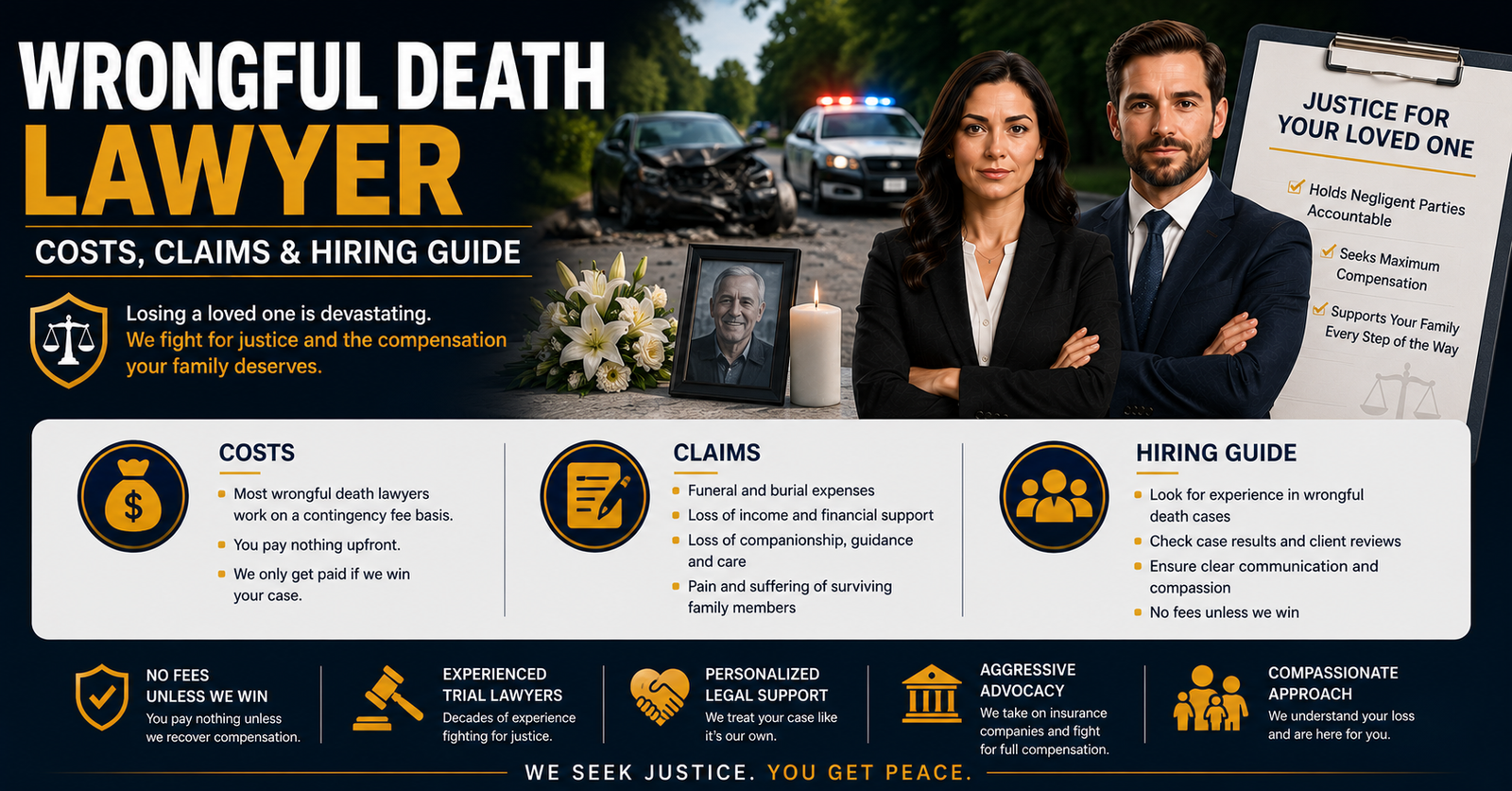
A wrongful death lawyer helps surviving family members pursue legal claims when someone dies because of another party’s negligence or wrongful conduct. These attorneys investigate the circumstances, gather evidence, negotiate with insurance companies, and represent families throughout the wrongful death claim or lawsuit process while protecting their legal rights.
Wrongful Death Lawyer: Costs, Claims & Hiring Guide
Losing a loved one unexpectedly is one of life’s most difficult experiences. When the death may have resulted from another person’s negligence, a dangerous product, medical mistake, workplace incident, or another wrongful act, surviving family members often have questions about their legal rights.
Many people searching for a wrongful death lawyer are not simply looking for legal definitions. They want practical information about whether they may have a claim, who can file a lawsuit, how much hiring a lawyer may cost, how the legal process works, what evidence is required, and what happens after a claim is filed.
This guide explains the role of a wrongful death lawyer, common causes of wrongful death claims, legal procedures, attorney fees, compensation factors, and important considerations before hiring legal representation.
What Is a Wrongful Death Lawyer?
A wrongful death lawyer is a personal injury attorney who represents surviving family members or the legal representative of a deceased person’s estate when a death allegedly results from negligence, recklessness, malpractice, or another wrongful act.
The attorney investigates the circumstances surrounding the death, determines whether a legal claim may exist, identifies potentially responsible parties, negotiates with insurance companies, and represents clients throughout settlement negotiations or court proceedings.
What Is a Wrongful Death Claim?
A wrongful death claim is a civil lawsuit seeking financial compensation for losses suffered by surviving family members after a person’s death caused by another party’s legally actionable conduct.
Unlike criminal proceedings, which seek punishment for unlawful conduct, wrongful death lawsuits generally focus on recovering financial damages permitted under applicable civil laws.
When Should You Contact a Wrongful Death Lawyer?
Early legal advice may help preserve evidence, protect legal rights, and ensure important filing deadlines are not missed.
- A loved one died in a motor vehicle accident caused by another driver.
- A fatal workplace accident occurred.
- A death followed possible medical negligence.
- A dangerous or defective product caused fatal injuries.
- A fatal construction accident occurred.
- Unsafe property conditions contributed to the death.
- A nursing home resident died under suspicious circumstances.
- You are uncertain whether negligence played a role.
Common Causes of Wrongful Death Cases
| Cause | Examples |
|---|---|
| Motor Vehicle Accidents | Car, truck, motorcycle, bicycle, and pedestrian collisions |
| Medical Malpractice | Surgical errors, delayed diagnosis, medication mistakes |
| Workplace Accidents | Industrial incidents, falls, equipment failures |
| Construction Accidents | Falls from heights, machinery accidents, structural failures |
| Defective Products | Unsafe consumer products or equipment failures |
| Nursing Home Negligence | Neglect, abuse, medication errors |
| Premises Liability | Unsafe buildings or hazardous property conditions |
| Aviation or Transportation Accidents | Commercial or private transportation incidents |
Who May Be Eligible to File a Wrongful Death Claim?
Eligibility varies by jurisdiction, but wrongful death laws generally identify specific individuals who may have the legal authority to file a claim.
| Potential Claimant | Possible Eligibility |
|---|---|
| Spouse | Often eligible under state wrongful death laws |
| Children | May qualify depending on jurisdiction |
| Parents | May qualify in certain situations |
| Estate Representative | Frequently authorized to file on behalf of beneficiaries |
| Other Dependents | Eligibility depends on local laws |
Because wrongful death statutes differ significantly between jurisdictions, consulting a qualified attorney is important before filing a claim.
What Does a Wrongful Death Lawyer Do?
- Investigates the cause of death.
- Collects medical records and accident reports.
- Interviews witnesses.
- Works with medical and financial experts when appropriate.
- Determines potential legal liability.
- Calculates recoverable damages.
- Negotiates with insurance companies.
- Files wrongful death lawsuits when necessary.
- Represents clients during mediation and trial.
- Handles settlement negotiations.
Requirements for Filing a Wrongful Death Lawsuit
Although requirements vary by jurisdiction, a successful claim generally requires sufficient evidence supporting several legal elements.
| Requirement | Description |
|---|---|
| Duty of Care | The defendant owed a legal duty. |
| Breach of Duty | The duty was allegedly violated. |
| Causation | The conduct allegedly contributed to the death. |
| Damages | The surviving family suffered legally recognized losses. |
Evidence Commonly Used in Wrongful Death Cases
- Death certificate.
- Medical records.
- Autopsy reports where available.
- Police or accident reports.
- Photographs and videos.
- Witness statements.
- Expert opinions.
- Employment and income records.
- Insurance documents.
- Maintenance or inspection records.
- Product documentation.
- Hospital records.
How Much Does a Wrongful Death Lawyer Cost?
Many wrongful death lawyers represent clients using a contingency fee arrangement. Under this type of agreement, attorney fees are generally paid only if compensation is successfully recovered. However, fee structures vary depending on the attorney, jurisdiction, and type of case.
| Fee Type | Description |
|---|---|
| Contingency Fee | Attorney fees are generally based on a percentage of any recovery. |
| Hourly Fee | Less common for wrongful death litigation. |
| Retainer Agreement | May apply in limited legal services. |
| Case Expenses | Court filing fees, expert witnesses, medical records, investigations, and litigation costs may be handled separately depending on the agreement. |
Before hiring a lawyer, request a written fee agreement explaining attorney fees, litigation expenses, and how costs will be handled if the case does not result in recovery.
Wrongful Death Claim Process
Step 1: Initial Consultation
The lawyer reviews the circumstances of the death, available evidence, potential defendants, and applicable legal deadlines.
Step 2: Investigation
The attorney gathers accident reports, medical records, witness statements, photographs, videos, expert opinions, and other evidence to determine whether a viable claim exists.
Step 3: Determining Liability
The investigation identifies individuals, companies, healthcare providers, manufacturers, or other parties who may bear legal responsibility.
Step 4: Calculating Damages
The lawyer evaluates financial losses, funeral expenses, medical bills, lost future earnings, loss of support, and other recoverable damages permitted by law.
Step 5: Insurance Claim and Settlement Negotiations
In many cases, the attorney first negotiates with insurance companies in an effort to resolve the matter without trial while protecting the family’s legal interests.
Step 6: Filing the Wrongful Death Lawsuit
If settlement negotiations do not resolve the claim or legal deadlines require court action, the attorney may file a wrongful death lawsuit in the appropriate court. The complaint outlines the legal basis for the claim, identifies the parties involved, and describes the damages being sought.
Step 7: Discovery Process
During discovery, both sides exchange relevant information and evidence. This phase allows each party to evaluate the strengths and weaknesses of the case before trial.
The discovery process may include:
- Written questions (interrogatories).
- Requests for documents and records.
- Depositions of witnesses and experts.
- Medical record reviews.
- Accident reconstruction reports.
- Expert witness opinions.
Step 8: Settlement Discussions
Many wrongful death claims are resolved through negotiated settlements before reaching trial. Settlement discussions may occur at various stages of the case, including after discovery or during mediation.
A settlement may provide certainty and avoid the time and expense associated with trial, but every case is unique. Families should carefully review any proposed settlement with their attorney before making a decision.
Step 9: Trial
If the parties cannot reach an agreement, the case may proceed to trial. During trial, both sides present evidence, question witnesses, and make legal arguments. A judge or jury determines liability and, where appropriate under applicable law, the amount of recoverable damages.
Settlement vs. Trial
| Settlement | Trial |
|---|---|
| Often resolves the case sooner. | May take considerably longer. |
| Provides greater certainty regarding the outcome. | The final decision is made by a judge or jury. |
| Generally involves private negotiations. | Court proceedings are often public. |
| May reduce litigation expenses. | May involve higher litigation costs. |
| Both parties must voluntarily agree. | A judicial decision resolves disputed issues. |
What Compensation May Be Available?
The damages available in a wrongful death case depend on the laws of the jurisdiction and the facts of the case. Compensation is intended to address legally recognized losses rather than punish every instance of negligence.
| Potential Damage | Description |
|---|---|
| Medical Expenses | Medical treatment received before death. |
| Funeral and Burial Costs | Reasonable funeral and burial expenses. |
| Loss of Financial Support | Income and financial contributions the deceased may have provided. |
| Loss of Household Services | The value of services the deceased performed for the family. |
| Loss of Companionship | Compensation that may be available under certain state laws. |
| Estate-Related Damages | Damages recoverable by the estate where permitted. |
The specific damages available vary by jurisdiction, and not every category applies in every wrongful death case.
Factors That May Affect Compensation
| Factor | Potential Impact |
|---|---|
| Age of the Deceased | May influence economic loss calculations. |
| Employment History | Future earning capacity may be evaluated. |
| Number of Dependents | Financial dependency may affect certain damages. |
| Available Evidence | Strong documentation may strengthen the claim. |
| Degree of Negligence | Applicable negligence laws differ by jurisdiction. |
| Insurance Coverage | Available insurance may influence recovery options. |
Statute of Limitations
Every jurisdiction establishes deadlines for filing wrongful death lawsuits, commonly referred to as the statute of limitations.
Missing the applicable filing deadline may prevent a family from pursuing a claim, even if the underlying case appears strong. Because these deadlines vary significantly by state and by the circumstances of the death, seeking legal advice promptly is often advisable.
Choosing the Right Wrongful Death Lawyer
Selecting legal representation is an important decision. Experience, communication, and transparency are often more valuable than advertising claims or promises.
- Look for significant experience handling wrongful death and serious injury cases.
- Ask about the attorney’s litigation and settlement experience.
- Understand how contingency fees and litigation expenses are handled.
- Ask who will personally manage your case.
- Discuss expected communication throughout the case.
- Review professional credentials and client feedback.
- Determine whether the attorney has access to qualified expert witnesses when appropriate.
- Request a written fee agreement before hiring.
Questions to Ask Before Hiring a Wrongful Death Lawyer
- How many wrongful death cases have you handled?
- Have you represented families in cases similar to mine?
- How are attorney fees calculated?
- What litigation expenses might arise?
- Who will be my primary contact throughout the case?
- How often will I receive updates?
- Will expert witnesses likely be necessary?
- What documents should I begin collecting?
- What filing deadlines apply to my situation?
- What options are available if settlement negotiations are unsuccessful?
Benefits of Hiring a Wrongful Death Lawyer
- Professional evaluation of potential legal claims.
- Assistance gathering and preserving important evidence.
- Communication with insurance companies on your behalf.
- Accurate preparation and filing of legal documents.
- Representation during negotiations, mediation, and trial.
- Guidance regarding legal procedures and deadlines.
- Access to experts when appropriate for complex cases.
Risks and Considerations
- Wrongful death litigation can take months or longer depending on the complexity of the case.
- Legal proceedings may be emotionally difficult for surviving family members.
- Court outcomes depend on evidence, applicable laws, and the specific facts of each case.
- Settlement negotiations may not always result in an agreement.
- No attorney can ethically guarantee compensation or a successful outcome.
Important Legal Considerations
Wrongful death laws, filing requirements, recoverable damages, and statutes of limitation differ significantly among jurisdictions.
Consulting a qualified attorney as early as possible may help preserve evidence, identify applicable legal deadlines, and evaluate available legal options.
Every wrongful death claim is unique, and prior case results do not guarantee future outcomes.
Educational Disclaimer
This information is for educational purposes only and should not be considered legal advice. Laws and legal procedures may vary by jurisdiction.
Frequently Asked Questions
What does a wrongful death lawyer do?
A wrongful death lawyer investigates fatal accidents, gathers evidence, negotiates with insurance companies, files lawsuits when necessary, and represents surviving family members throughout the legal process.
Who can file a wrongful death lawsuit?
Eligibility depends on state law. In many jurisdictions, spouses, children, parents, or the personal representative of the deceased person’s estate may have the authority to file a claim.
How much does a wrongful death lawyer cost?
Many attorneys handle wrongful death claims through contingency fee agreements, although fee structures vary depending on the attorney and jurisdiction.
How long does a wrongful death case take?
The timeline depends on factors such as the complexity of the case, the amount of evidence, settlement negotiations, court schedules, and whether the matter proceeds to trial.
Will my case go to trial?
Not necessarily. Many wrongful death claims are resolved through negotiated settlements, but some require trial when the parties cannot reach an agreement.
What evidence is important in a wrongful death case?
Medical records, accident reports, witness statements, expert opinions, photographs, videos, and financial documents are commonly used as evidence.
Can a wrongful death lawyer guarantee compensation?
No. Ethical attorneys cannot guarantee settlements, verdicts, or specific compensation amounts.
How soon should I contact a lawyer?
Speaking with an attorney promptly may help preserve evidence and ensure compliance with applicable filing deadlines.
What is the difference between a wrongful death claim and a criminal case?
A wrongful death claim is a civil action seeking financial damages, while a criminal case is brought by the government to determine criminal responsibility.
How do I choose the right wrongful death lawyer?
Consider the attorney’s experience, communication style, fee structure, professional credentials, and familiarity with cases involving serious injury or wrongful death.
Related Topics
- Wrongful Death Claim Attorney: Lawsuit Process and Compensation Guide
- Accidental Death Lawyer: Legal Rights After a Fatal Accident
- Medical Malpractice Lawyer: Fatal Medical Negligence Claims
- Truck Accident Attorney: Fatal Commercial Vehicle Accident Claims
- Personal Injury Lawyer: Serious Injury and Wrongful Death Cases