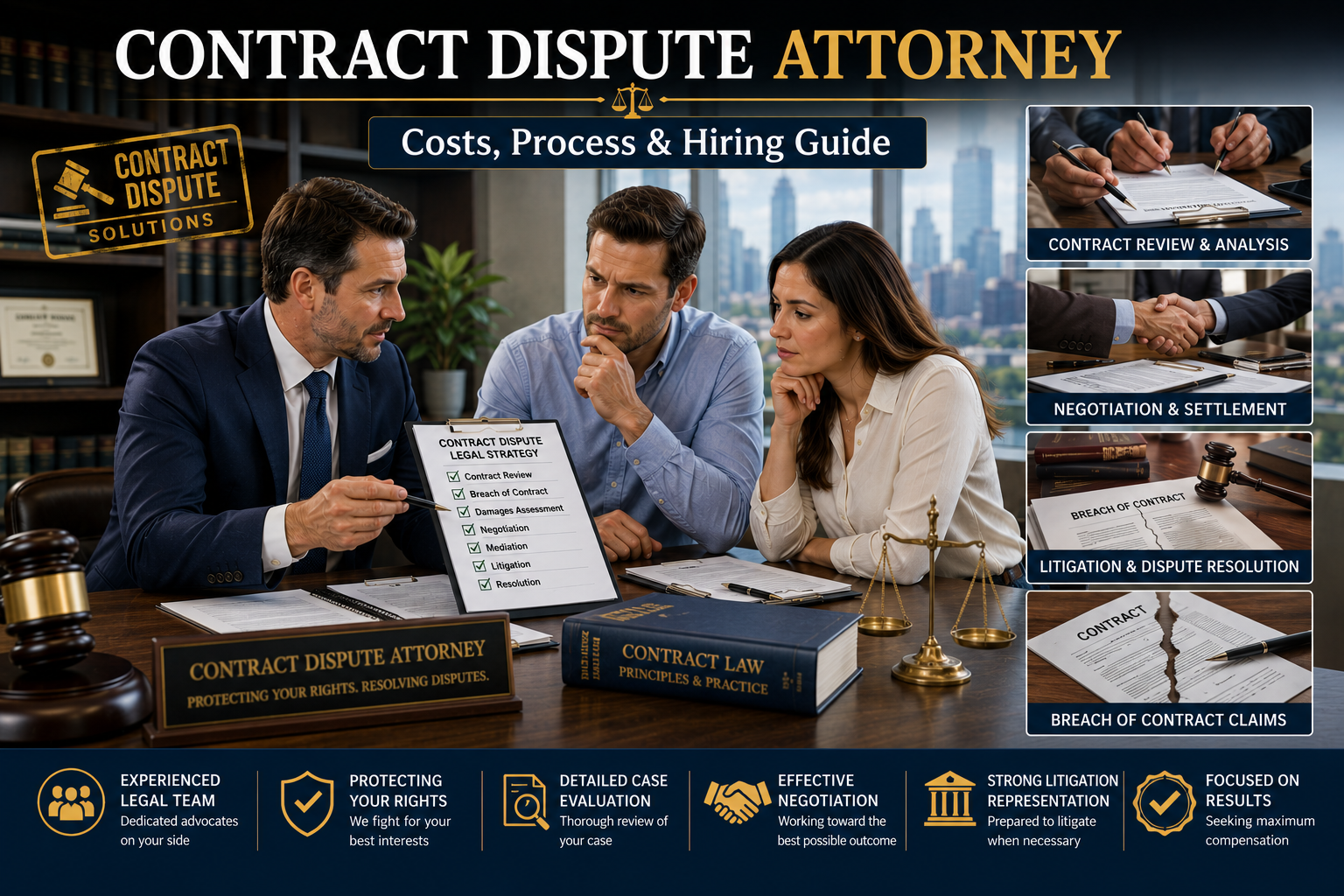
A contract dispute attorney helps individuals and businesses resolve disagreements involving contracts, including breach of contract claims, payment disputes, and business conflicts. These attorneys review agreements, evaluate legal rights, negotiate settlements, and represent clients in mediation, arbitration, or court proceedings.
Contract Dispute Attorney: Costs, Process & Hiring Guide
Contracts play a critical role in both personal and business relationships. Whether the agreement involves a business partnership, employment arrangement, construction project, vendor relationship, or service agreement, disputes can arise when one party fails to meet contractual obligations.
Many people search for a contract dispute attorney because they are facing unpaid invoices, broken agreements, missed deadlines, or disagreements over contract terms and want to understand their legal options.
This guide explains what a contract dispute attorney does, common types of contract disputes, legal requirements, attorney costs, and the process for resolving contract-related conflicts.
What Is a Contract Dispute Attorney?
A contract dispute attorney is a lawyer who represents individuals, professionals, and businesses involved in disagreements arising from written or oral agreements. These attorneys analyze contracts, identify legal issues, advise clients regarding their rights and obligations, and pursue dispute resolution through negotiation, mediation, arbitration, or litigation.
Contract dispute lawyers often handle both personal and commercial disputes involving significant financial interests.
When Should You Hire a Contract Dispute Attorney?
Consulting an attorney may be beneficial whenever a contractual disagreement involves substantial financial exposure or complex legal issues.
- A party failed to fulfill contractual obligations.
- You are owed money under a contract.
- Another party claims you breached an agreement.
- The contract language is unclear or disputed.
- Negotiations have failed.
- The dispute involves significant financial losses.
- The contract requires arbitration or mediation.
- You received legal notices related to the dispute.
Common Types of Contract Disputes
| Dispute Type | Examples |
|---|---|
| Breach of Contract | Failure to perform agreed obligations |
| Payment Disputes | Unpaid invoices or outstanding balances |
| Business Contract Disputes | Vendor, supplier, or partnership disagreements |
| Employment Contract Disputes | Compensation or employment agreement conflicts |
| Construction Contract Disputes | Project delays, defects, or payment issues |
| Real Estate Contract Disputes | Purchase agreement or lease disagreements |
What Is a Breach of Contract?
A breach of contract generally occurs when one party fails to perform duties required by a legally enforceable agreement without lawful justification.
| Breach Type | Description |
|---|---|
| Material Breach | A significant failure that defeats the purpose of the agreement |
| Minor Breach | A partial failure that does not substantially destroy the contract’s value |
| Anticipatory Breach | A party indicates they will not fulfill future obligations |
| Actual Breach | A party directly fails to perform required duties |
What Does a Contract Dispute Attorney Do?
- Review and interpret contracts.
- Assess potential breaches and legal claims.
- Explain contractual rights and obligations.
- Negotiate settlements and resolutions.
- Prepare demand letters.
- Represent clients during mediation or arbitration.
- File lawsuits when necessary.
- Represent clients during court proceedings and trial.
Requirements Often Needed to Pursue a Breach of Contract Claim
Legal requirements vary by jurisdiction, but claimants generally must establish several elements.
| Requirement | Description |
|---|---|
| Valid Contract | A legally enforceable agreement existed. |
| Performance | The claimant fulfilled obligations or had a valid excuse. |
| Breach | The opposing party failed to perform. |
| Damages | The claimant suffered measurable losses. |
Important Evidence in Contract Disputes
- Written contracts and amendments.
- Email correspondence and text messages.
- Invoices and payment records.
- Receipts and financial statements.
- Business records and reports.
- Meeting notes and communications.
- Witness statements.
- Photographs, project records, or work documentation.
How Much Does a Contract Dispute Attorney Cost?
Attorney fees vary depending on dispute complexity, claim value, and the legal services required.
| Fee Structure | Description |
|---|---|
| Initial Consultation | Free or flat consultation fee |
| Hourly Billing | Attorney charges based on time spent |
| Flat Fee | Used for specific services or limited representation |
| Retainer Agreement | Advance payment applied to future legal services |
| Contingency Fee | Available in limited situations |
Business litigation and contract disputes are frequently billed hourly because the amount of work required may vary significantly from case to case.
Contract Dispute Resolution Options
| Resolution Method | Description | Typical Advantages |
|---|---|---|
| Negotiation | Parties attempt voluntary settlement. | Lower cost and greater flexibility |
| Mediation | A neutral mediator facilitates discussions. | Confidential and collaborative |
| Arbitration | A neutral arbitrator issues a decision. | Often faster than litigation |
| Litigation | Dispute resolved through court proceedings. | Formal legal process and judicial oversight |
Contract Dispute Process
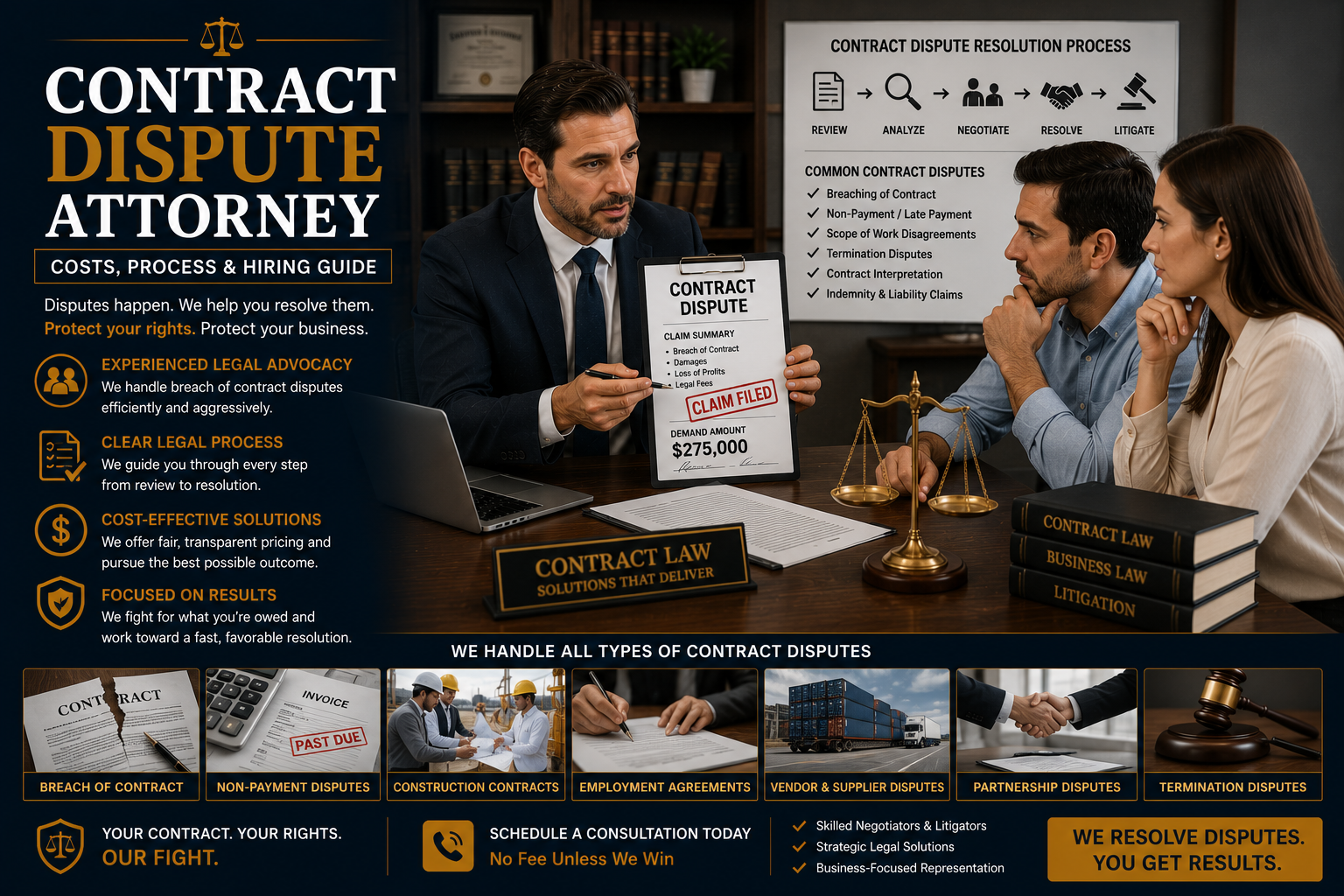
Step 1: Review the Contract
The attorney examines the agreement to determine applicable rights, obligations, and dispute procedures.
Step 2: Evaluate Potential Claims
The facts and available evidence are analyzed to identify possible legal claims or defenses.
Step 3: Attempt Informal Resolution
Many disputes are initially addressed through discussions or demand letters.
Step 4: Negotiate a Settlement
The parties may negotiate a mutually acceptable resolution.
Step 5: Participate in Mediation or Arbitration
Some contracts require alternative dispute resolution before litigation.
Step 6: File a Lawsuit if Necessary
If informal resolution fails, legal proceedings may begin.
Step 7: Discovery and Evidence Exchange
The parties exchange documents, information, and testimony.
Step 8: Trial or Final Resolution
The dispute may conclude through settlement, arbitration, or court judgment.
Potential Remedies in Contract Disputes
| Remedy | Description |
|---|---|
| Monetary Damages | Compensation for financial losses |
| Specific Performance | Court order requiring contractual performance |
| Contract Rescission | Cancellation of the agreement |
| Declaratory Relief | Court clarification of contractual rights |
| Injunctive Relief | Court order requiring or prohibiting certain conduct |
No attorney can ethically guarantee recovery amounts or successful outcomes in litigation.
Factors That May Affect a Contract Dispute
| Factor | Potential Impact |
|---|---|
| Contract Language | Clear language may simplify disputes |
| Available Evidence | Documentation may strengthen claims |
| Financial Damages | The amount at stake may affect strategy |
| Dispute Resolution Clauses | May require mediation or arbitration |
| Applicable Law | State laws may affect legal rights |
Benefits of Hiring a Contract Dispute Attorney
- Professional interpretation of contract language.
- Strategic evaluation of claims and defenses.
- Skilled negotiation and settlement assistance.
- Representation during mediation or arbitration.
- Courtroom advocacy when litigation becomes necessary.
- Protection of business and financial interests.
Risks and Considerations
- Litigation can be time-consuming and costly.
- Legal outcomes depend on evidence and applicable law.
- Business relationships may be affected by disputes.
- Alternative dispute resolution may be mandatory.
- Missing contractual deadlines can affect legal rights.
How to Choose the Right Contract Dispute Attorney
- Look for experience handling contract litigation.
- Ask about experience with similar disputes.
- Understand the attorney’s billing structure.
- Review communication practices.
- Determine who will personally handle the matter.
- Ask whether mediation or arbitration experience is available.
Questions to Ask Before Hiring an Attorney
- How many contract disputes have you handled?
- Have you managed disputes similar to mine?
- What fee structure do you use?
- Will my case likely require litigation?
- Does my contract require arbitration or mediation?
- What documents should I gather?
- What legal deadlines may apply?
Important Legal Considerations
Contract laws vary by jurisdiction, and many agreements contain provisions governing venue, arbitration, notice requirements, and dispute procedures. Missing contractual or statutory deadlines may affect legal rights.
Because early legal analysis may help preserve evidence and evaluate available options, many individuals and businesses consult a contract dispute attorney shortly after a disagreement arises.
No attorney can ethically guarantee settlement amounts, court judgments, or successful outcomes.
Educational Disclaimer
This information is for educational purposes only and should not be considered legal advice. Laws and legal procedures may vary by jurisdiction.
Frequently Asked Questions
What does a contract dispute attorney do?
A contract dispute attorney reviews agreements, evaluates legal claims, negotiates settlements, and represents clients in dispute resolution proceedings.
How much does a contract dispute attorney cost?
Many attorneys charge hourly rates, although fee structures vary depending on the case and services required.
What is considered a breach of contract?
A breach generally occurs when a party fails to perform contractual obligations without lawful justification.
Can oral contracts be enforced?
Some oral agreements may be legally enforceable, although enforceability depends on applicable law and circumstances.
Do all contract disputes go to court?
No. Many disputes are resolved through negotiation, mediation, or arbitration.
What evidence is important in a contract dispute?
Contracts, communications, invoices, payment records, and witness testimony are often important evidence.
Can a lawyer guarantee success in a contract dispute?
No attorney can ethically guarantee a particular legal outcome.
How long does a contract dispute take?
The timeline varies depending on the complexity of the dispute, negotiation efforts, and whether litigation becomes necessary.
What remedies are available for breach of contract?
Potential remedies may include damages, specific performance, rescission, or injunctive relief depending on the circumstances.
When should I contact a contract dispute attorney?
Many individuals and businesses seek legal advice soon after a dispute arises to understand their rights and preserve evidence.
Related Topics
- Business Litigation Lawyer: Commercial Dispute Resolution
- Corporate Lawyer: Business Contracts and Compliance
- Breach of Contract Lawyer: Legal Remedies and Claims
- Commercial Litigation Attorney: Business Lawsuit Guide
- Business Attorney: Legal Services for Companies