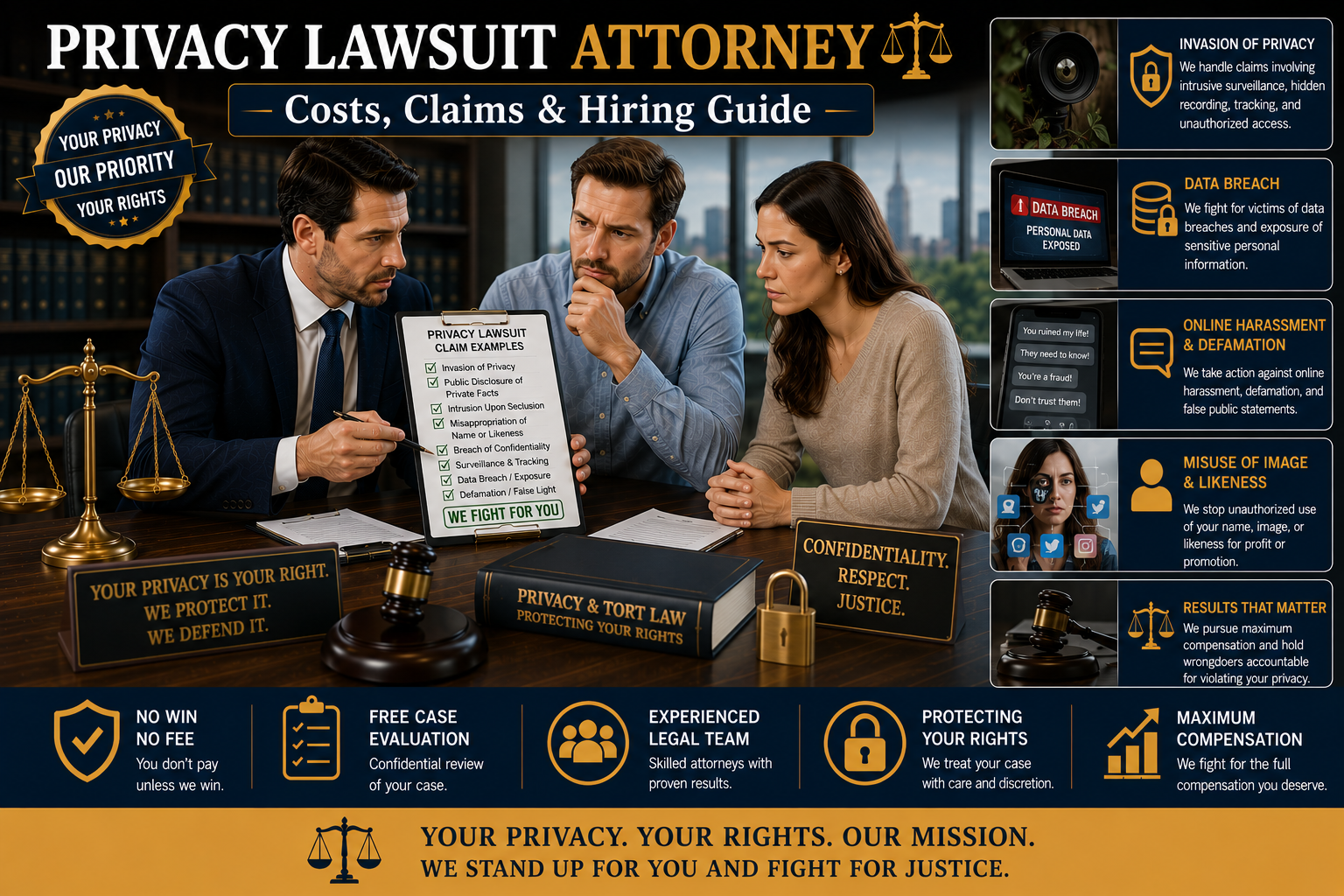
A privacy lawsuit attorney helps individuals and businesses pursue or defend legal claims involving data breaches, invasion of privacy, unauthorized disclosure of personal information, and other privacy violations. These attorneys evaluate legal rights, gather evidence, negotiate settlements, and represent clients during litigation.
Privacy Lawsuit Attorney: Costs, Claims & Hiring Guide
Personal information is collected, stored, and shared more than ever before. When sensitive information is exposed, misused, or accessed without authorization, individuals and businesses may suffer financial losses, reputational harm, and significant emotional distress.
Many people search for a privacy lawsuit attorney because they believe their privacy rights were violated and want to understand whether they have a legal claim, what compensation may be available, how much an attorney costs, and what steps are involved in pursuing legal action.
This guide explains what a privacy lawsuit attorney does, common privacy claims, legal requirements, attorney fees, and the process involved in resolving privacy disputes.
What Is a Privacy Lawsuit Attorney?
A privacy lawsuit attorney is a lawyer who handles legal disputes involving personal information, privacy rights, data protection, and unauthorized use or disclosure of confidential information.
These attorneys represent individuals, consumers, employees, businesses, and organizations in matters involving data breaches, identity theft, unauthorized surveillance, online privacy violations, and invasion of privacy claims.
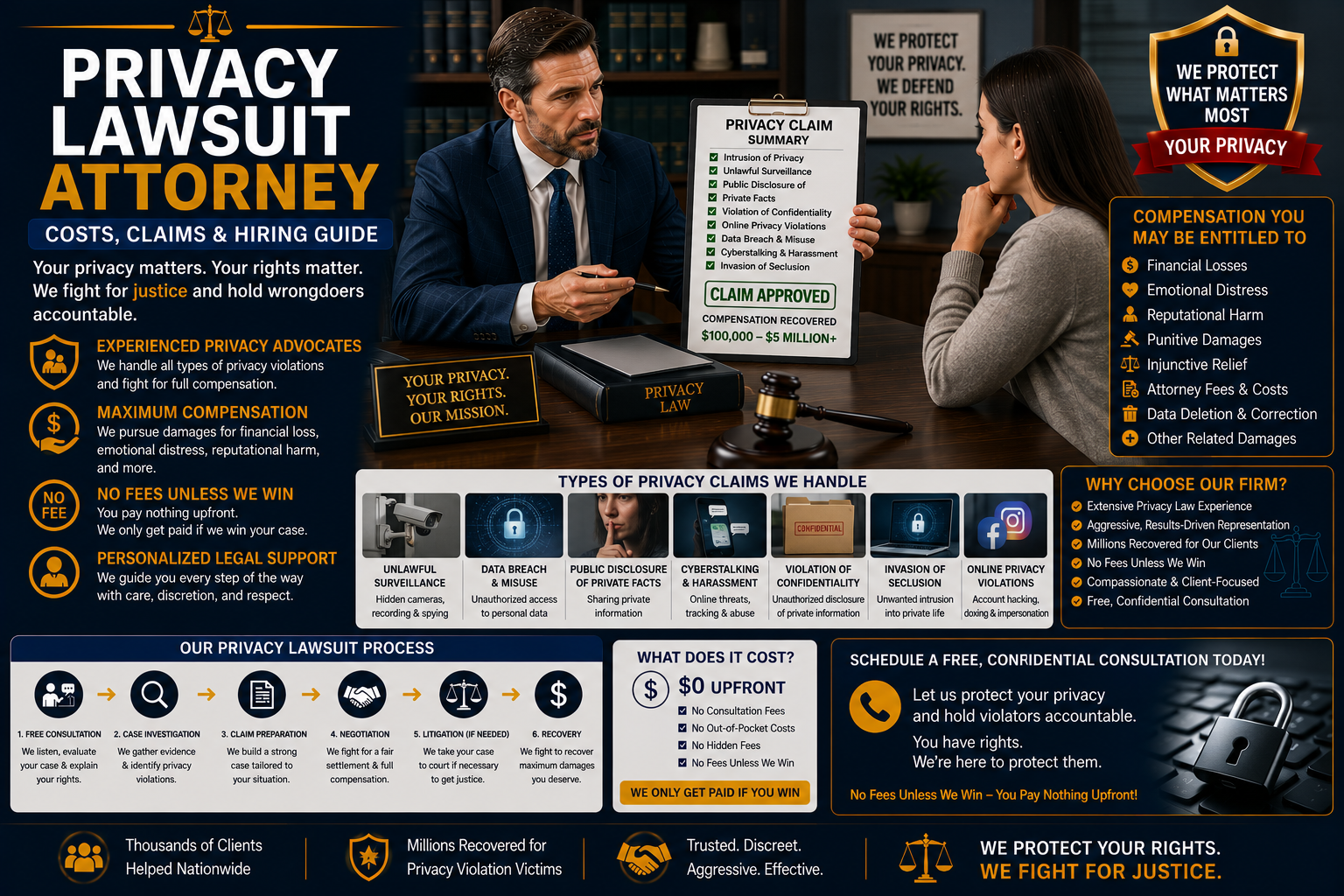
When Should You Hire a Privacy Lawsuit Attorney?
Legal advice may be appropriate when a privacy violation results in financial harm, identity theft risks, reputational damage, or significant personal losses.
- Your personal information was exposed in a data breach.
- A company disclosed your private information without authorization.
- You are a victim of identity theft linked to a data incident.
- Your confidential medical or financial information was improperly shared.
- You believe you were unlawfully recorded or monitored.
- Your image or likeness was used without permission.
- You received notice that sensitive consumer information was compromised.
- You are a business facing allegations of privacy violations.
Common Privacy Lawsuits
| Claim Type | Examples |
|---|---|
| Data Breach Claims | Unauthorized access to consumer or employee information |
| Invasion of Privacy | Unlawful intrusion into personal affairs |
| Unauthorized Disclosure | Improper release of confidential information |
| Identity Theft Claims | Misuse of personal information causing damages |
| Medical Privacy Violations | Improper disclosure of healthcare information |
| Workplace Privacy Claims | Improper employee monitoring or disclosure |
| Online Privacy Violations | Improper collection or sharing of online user data |
What Does a Privacy Lawsuit Attorney Do?
- Evaluate potential privacy law violations.
- Review contracts, privacy policies, and disclosure practices.
- Investigate how personal information was accessed or disclosed.
- Assess financial and non-financial damages.
- Gather evidence supporting legal claims.
- Negotiate settlements.
- Represent clients in class actions or individual lawsuits.
- Defend businesses accused of privacy violations.
- Represent clients during litigation, mediation, and appeals.
Common Causes of Privacy Lawsuits
| Cause | Examples |
|---|---|
| Cybersecurity Failures | Weak security measures leading to data exposure |
| Unauthorized Access | Employees or third parties improperly accessing information |
| Improper Data Sharing | Disclosure without valid consent |
| Negligent Data Storage | Failure to adequately secure personal information |
| Unauthorized Surveillance | Improper recording or monitoring activities |
Requirements Often Needed for a Privacy Lawsuit
Legal requirements vary depending on the type of privacy claim and applicable laws.
| Requirement | Description |
|---|---|
| Protected Information | Personal or confidential information was involved |
| Unauthorized Conduct | Improper access, disclosure, or use occurred |
| Damages or Harm | The plaintiff suffered legally recognized harm |
| Supporting Evidence | Documentation supports the allegations |
Important Evidence in Privacy Cases
- Data breach notifications.
- Email communications and correspondence.
- Privacy policies and terms of service.
- Identity theft documentation.
- Financial records showing losses.
- Medical or employment records where relevant.
- Digital records and forensic evidence.
- Witness statements.
How Much Does a Privacy Lawsuit Attorney Cost?
Attorney fees depend on the complexity of the dispute, damages involved, and the legal services required.
| Fee Structure | Description |
|---|---|
| Hourly Billing | Attorney charges based on time spent on the matter |
| Contingency Fee | May be available in certain plaintiff cases |
| Flat Fee | Sometimes used for limited legal services |
| Retainer Agreement | Advance payment applied toward future legal work |
Clients should carefully review fee agreements and discuss anticipated costs before hiring legal counsel.
Privacy Lawsuit Process
Step 1: Identify the Privacy Violation
Determine what information was exposed, how the incident occurred, and who may be responsible.
Step 2: Preserve Evidence
Keep breach notifications, communications, financial records, screenshots, and related documentation.
Step 3: Consult a Privacy Lawsuit Attorney
An attorney evaluates the facts and determines whether legal claims may exist.
Step 4: Investigate the Incident
The legal team may review technical records, company practices, and relevant laws.
Step 5: Calculate Damages
Potential financial losses and other damages are assessed.
Step 6: Settlement Discussions
Many privacy disputes are resolved through negotiation or mediation.
Step 7: File a Lawsuit if Necessary
If settlement efforts are unsuccessful, formal legal proceedings may begin.
Step 8: Resolution
The matter may conclude through settlement, arbitration, or court judgment.
Potential Compensation in Privacy Lawsuits
| Potential Compensation | Examples |
|---|---|
| Financial Losses | Reimbursement for documented monetary damages |
| Identity Theft Expenses | Costs related to restoring compromised accounts or records |
| Credit Monitoring Costs | Expenses associated with monitoring financial accounts |
| Emotional Distress Damages | Compensation where permitted by law |
| Statutory Damages | Amounts authorized under certain privacy laws |
| Settlement Agreements | Negotiated resolutions between parties |
No attorney can ethically guarantee compensation amounts, settlement values, or successful legal outcomes.
Factors That May Affect a Privacy Lawsuit
| Factor | Potential Impact |
|---|---|
| Type of Information Exposed | Sensitive information may increase potential damages |
| Extent of Harm | Documented losses may affect the claim |
| Available Evidence | Strong evidence may support legal claims |
| Applicable Privacy Laws | Federal, state, and international laws may apply |
| Filing Deadlines | Missing deadlines may affect legal rights |
Benefits of Hiring a Privacy Lawsuit Attorney
- Professional evaluation of privacy rights.
- Experience interpreting complex privacy laws.
- Assistance preserving digital evidence.
- Representation during settlement negotiations.
- Guidance regarding class actions and litigation.
- Access to technical and forensic experts when necessary.
Risks and Considerations
- Privacy laws vary significantly by jurisdiction.
- Digital evidence may require technical analysis.
- Litigation can be time-consuming and expensive.
- Legal outcomes depend on evidence and applicable laws.
- Not every data incident results in a valid lawsuit.
Time Limits for Filing a Privacy Lawsuit
Privacy claims are subject to statutes of limitations that vary depending on the type of claim and jurisdiction.
Individuals and businesses often seek legal advice promptly after discovering a potential privacy violation to preserve evidence and protect legal rights.
How to Choose the Right Privacy Lawsuit Attorney
- Look for experience handling privacy and data breach litigation.
- Ask about experience with cybersecurity and digital evidence.
- Understand the attorney’s fee arrangement.
- Discuss who will personally manage the case.
- Review communication practices.
- Ask about experience with class action litigation if applicable.
Questions to Ask Before Hiring a Lawyer
- How many privacy cases have you handled?
- Do you regularly handle data breach litigation?
- What fee arrangement do you use?
- Who will personally manage my case?
- What evidence should I preserve?
- What filing deadlines apply?
- Will technical experts likely be required?
Important Legal Considerations
Privacy laws, consumer protection statutes, cybersecurity regulations, and procedural rules vary significantly by jurisdiction.
Early legal consultation may help preserve evidence, identify potential claims, and evaluate available remedies.
No attorney can ethically guarantee compensation, settlement amounts, or successful outcomes.
Educational Disclaimer
This information is for educational purposes only and should not be considered legal advice. Laws and legal procedures may vary by jurisdiction.
Frequently Asked Questions
What does a privacy lawsuit attorney do?
A privacy lawsuit attorney handles disputes involving data breaches, privacy violations, unauthorized disclosures, and related legal claims.
How much does a privacy lawsuit attorney cost?
Attorney fees vary and may include hourly billing, contingency fees, flat fees, or retainers.
Can I sue after a data breach?
Whether legal action is available depends on applicable laws, damages, and the specific circumstances of the incident.
What evidence is important in a privacy lawsuit?
Data breach notices, communications, financial records, and digital evidence are often important.
Do all privacy disputes go to court?
No. Many disputes are resolved through negotiation, mediation, or settlement.
Can businesses hire privacy attorneys?
Yes. Businesses often retain privacy attorneys for compliance, defense, and litigation matters.
Can a lawyer guarantee compensation?
No attorney can ethically guarantee compensation or a specific legal outcome.
How long does a privacy lawsuit take?
The timeline depends on the complexity of the dispute, available evidence, and the legal process involved.
What should I do after discovering a privacy violation?
Preserve evidence, monitor accounts, document losses, and consider seeking legal advice promptly.
When should I contact a privacy lawsuit attorney?
Many individuals seek legal advice shortly after discovering a privacy violation or receiving notice of a data breach.
Related Topics
- Employment Dispute Lawyer
- Business Litigation Lawyer: Commercial Dispute Resolution Guide
- Employment Dispute Lawyer: Workplace Privacy Rights
- Contract Dispute Attorney: Breach of Contract Litigation Guide